Article
Humanoid robots: why the convergence moment is now

Humanoid robots: why the convergence moment is now

April 15, 2026

As hardware nears readiness and ecosystems take shape, strategic choices matter now

For years, humanoid robots remained a science fiction fantasy. Today, that is changing. Hardware is nearing functional maturity, venture capital is flowing at unprecedented scale and labor shortages are becoming an existential challenge across developed and developing economies alike. Advancements in AI model enable a software driven revolution. Together, these forces are creating an inflection point that strategic leaders cannot afford to ignore.

The Inflection Point - humanoid robots are a huge opportunity for several industry players, including automtoive, and we are moving from prototypes to industrial scale in a few years

A perfect storm

The timing is not accidental. Working-age populations are projected to decline sharply across key industrial regions by 2050, while workers are increasingly unwilling to accept harsh production environments. At the same time, advances in AI, actuators, compute and power systems have matured at a pace that few predicted. For the first time, the question is no longer whether humanoid robots will work – but how quickly they will scale across industrial and service environments.

Humanoid robots are moving from science fiction to reality – In factories, households and services. The economic opportunity is substantial. At projected operating costs of just USD 2 per hour, humanoid robots present a compelling case for regions facing both labor scarcity and rising wage pressures. Yet the pathway to large-scale deployment remains complex and today there are only very few productive use cases of humanoid robots

What this study answers

When will humanoid robots become economically viable at scale?

Which use cases will drive the first wave of deployment?

How are regional strategies diverging – and what will determine leadership?

How can companies monetize their capabilities in humanoid robotics, create new source of revenues by becoming a supplier or even an OEM?

The market opportunity of the century?

Humanoid robots are creating one of the most significant industrial market opportunities in decades. At projected operating costs of just USD 2 per hour, the economic case is compelling – particularly for regions facing structural labor shortages, with working-age populations set to decline by up to 22% by 2050. The OEM-level market alone could reach USD 750 billion by 2035 in the optimistic scenario – or USD 300 billion in the baseline – scaling to USD 2 trillion (baseline) and up to USD 4 trillion (optimistic) by 2050, rivaling today's automotive industry. If technological progress is slower than expected, growth could follow a more gradual trajectory – but even conservative projections point to a market of historic proportions. The opportunity extends far beyond the robots themselves. By 2035, the component and value chain landscape is projected to unlock substantial markets across key segments: e.g., motion actuators (up to USD 79 billion), skeleton & structural components (up to USD 42 billion), hand and end-effector systems (up to USD 26 billion).

Two strategies take shape

Two distinct strategies are taking shape across regions. China is pursuing rapid deployment and learning through scale, already piloting thousands of units in controlled environments. The West is betting on AI-first approaches, focusing on data, foundation models and generalization from structured to unstructured environments. These contrasting paths are creating separate industrial flywheels, with profound implications for which ecosystems will lead the market.

Beyond hardware: the ecosystem challenge

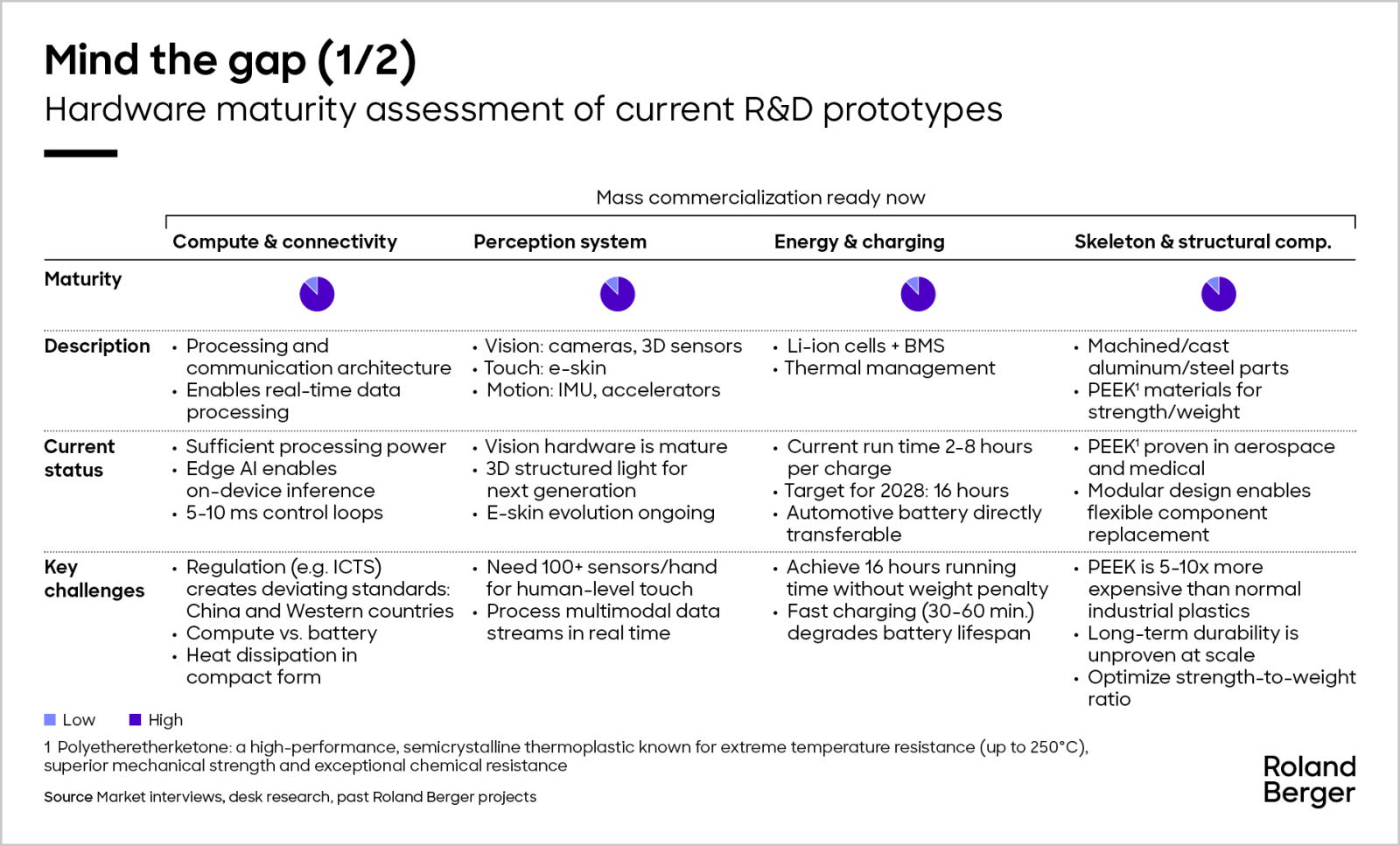
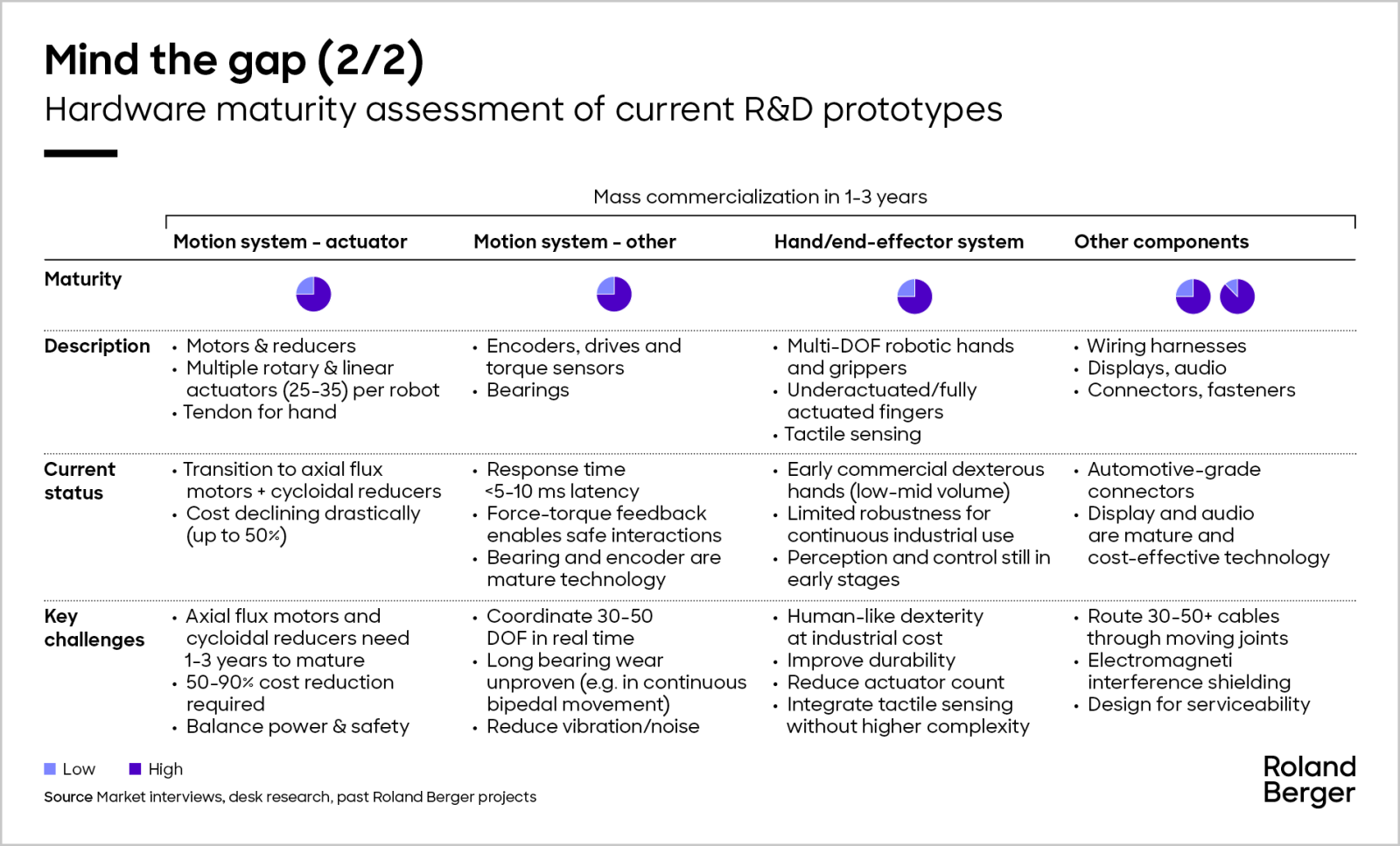
Hardware maturity does not mean market readiness. The broader ecosystem still trails by three to five years, held back by immature supply chains and fragmented regulatory frameworks, while the software-to-hardware gap persists. Safety standards remain ill-suited to human-centric environments, and data generation continues to constrain leading developers.

For operators, component suppliers and technology companies, that creates both risk and opportunity. The positions they take now – in partnerships and across the supply chain – will shape competitive advantage for the next decade.

Where value emerges first

The initial deployment wave will focus on narrow, well-defined tasks such as material handling, simple assembly and logistics. Success in these early use cases will unlock more complex applications – and reveal which companies positioned themselves early enough to capitalize. But the window for strategic positioning is narrow. Those who move now will shape product specifications and secure favorable economics, influencing how the technology evolves.

The convergence moment is now

Humanoid robotics represents one of the largest industrial opportunities emerging this decade. Yet uncertainty persists around timing and feasibility, as well as geographic leadership. Our analysis reveals the technological readiness levels, ecosystem gaps, regional dynamics and strategic positioning requirements that will determine winners and losers as the industry moves from prototypes to production.

The convergence is real. The question is not whether this market will scale – but who will win, and how quickly.

Request the full PDF here

Register now to access the full study. Furthermore, you get regular news and updates directly in your inbox.

Thank you for registering your interest. If you have not yet confirmed your email address with us you will receive an email shortly requesting you to do so. Once confirmed, you will receive the requested content directly via email.

Sorry, an error occured. Please try again later.

Further readings
Our global network