

Global alcohol volumes face permanent structural decline. Discover how Alco-Tech and Alco-Politics can redefine your strategy by 2035.


The innovation imperative
Why large F&B players must rethink how they grow
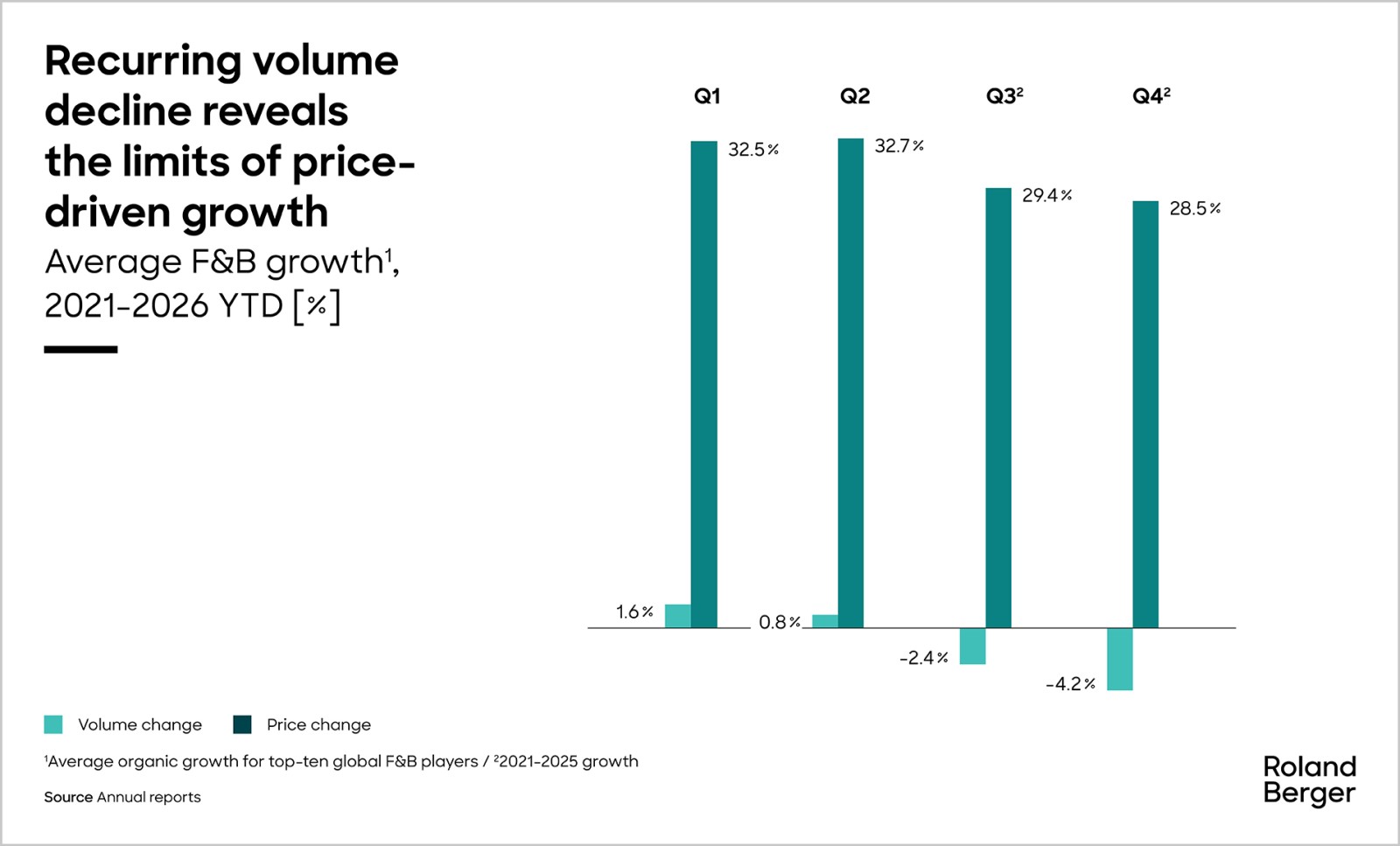
The food and beverage (F&B) market is changing in fundamental ways: consumer trends are emerging faster than ever, private label is gaining a solid market hold, and social media has become a powerful entry point for challengers. These changes have put large F&B players under considerable pressure, which is visible in structurally declining sales volumes – up to -4% since 2021 for the top-ten global F&B players.

Reactive F&B, stagnant growth
To maintain revenue growth, major F&B players have largely responded to the volume pressures by hiking up prices. While structural and strategic revenue growth management can drive real growth, focusing too much on price levers can erode consumer delight.
"Large F&B players need to rethink how they innovate. The structures that drive efficiency can also prevent them from responding quickly to changing consumer needs. "

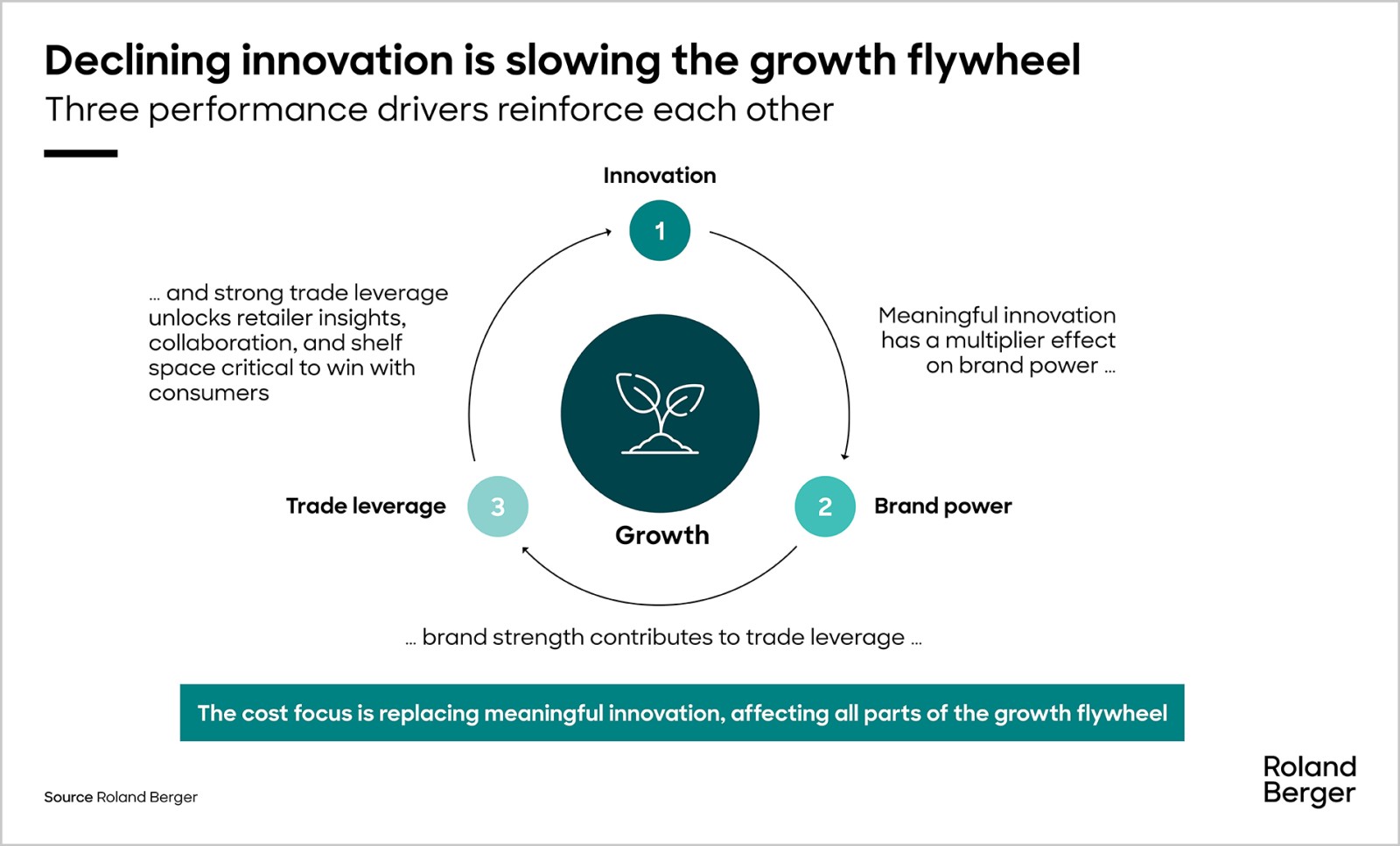
That does not mean that consumers are not willing to pay more for an innovative product. Investing in innovation is essential to increasing willingness-to-pay and consumer delight. What we see, however, is F&B companies focusing their innovation budgets on cost savings, such as cheaper input ingredients , instead of meaningful innovation. Without innovation that triggers consumer attention, the growth flywheel becomes stuck:
Cost-related innovation may help protect margins, but it goes unnoticed on the shelf. And if consumers are paying higher prices for the same products, this strategy does little for volumes and ultimately leads to weakened brand power.
Weaker brand power then erodes an F&B's leverage with retailers, as consumers reach for comparable but cheaper private label or more attractive challenger brands that offer more bang for the buck.
Eroded trade leverage translates into lost shelf share. When an F&B loses ground with retailers, consumer proximity drops, making it harder for that F&B to gain the insights it needs to get the growth flywheel moving again.
Innovation turned inward
Though innovation is essential for F&B relevance, companies are running their innovation pipelines through rigid governance structures that are designed for core business segments. This kind of top-down innovation control makes it difficult to adapt to – much less adopt – new opportunities. As a result, breakthrough ideas are often filtered out early, leaving organizations stuck with slow, inflexible processes that hinder meaningful progress:
- Narrow go/no-go criteria filter out originality.
- Siloed and distant teams and complex approval processes slow development.
- Lack of end-to-end ownership hampers innovation champions.
- Global go-to-market strategies struggle to gain consumer attention.
- Early post-launch benchmarking is too soon for meaningful iteration or scaling.
As organizations centralize innovation resources to drive efficiency, they move further away from the consumer. This means that established F&B players stay a step behind niche and emergent market signals, allowing challenger brands to grab the differentiation advantage and win market share. Meanwhile, they continue to lose ground to private label alternatives, which are rapidly gaining shelf space with tastes that are comparable and prices that are below their branded peers.
"To reignite the growth flywheel, F&B players must be sharper at turning consumer foresight into portfolio choices, supported by an innovation operating model built for speed to market."
_person_144.png?v=1966195)
Reclaiming momentum in the flywheel
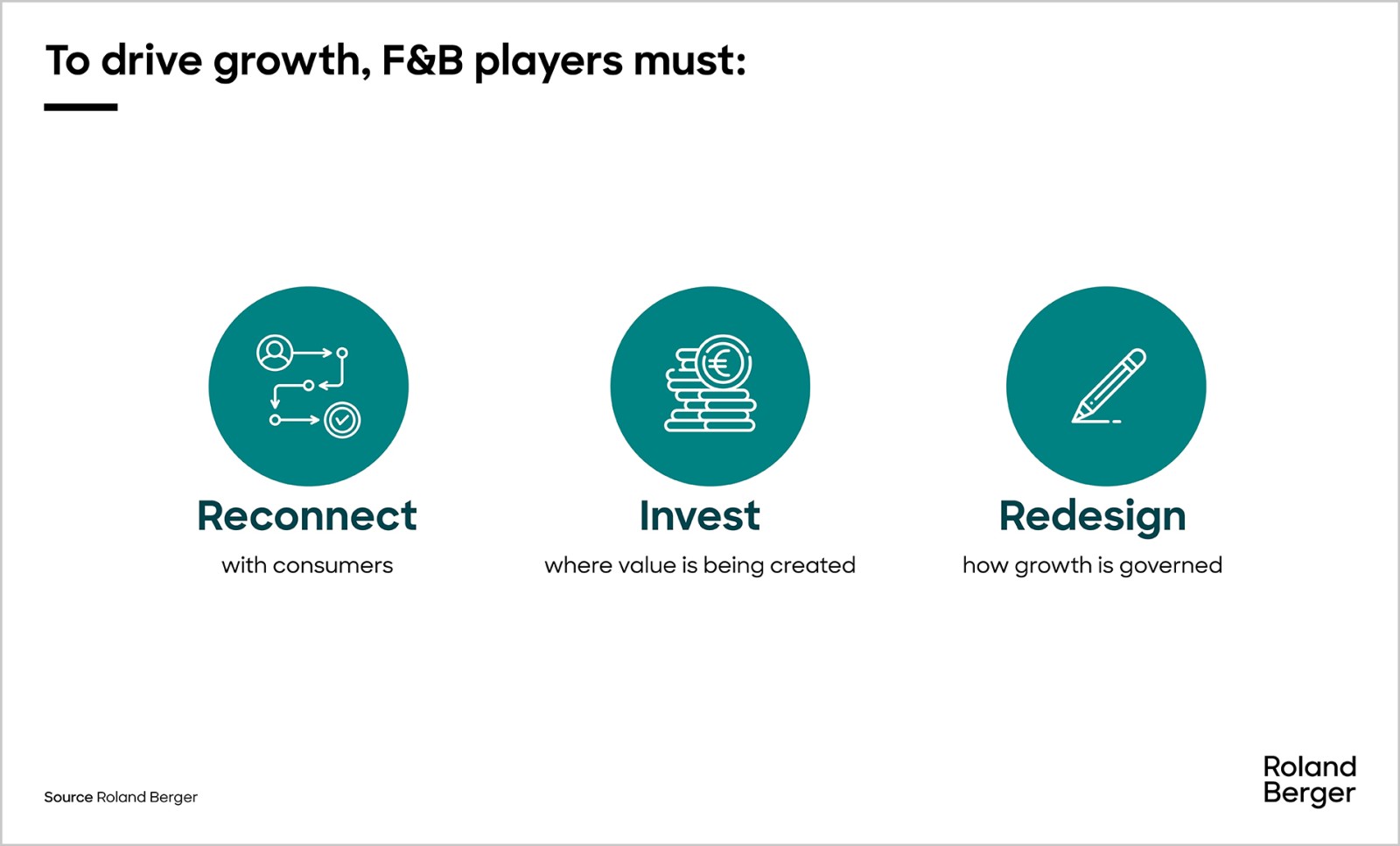
A renewed innovation strategy will break this cycle and get the growth flywheel running again. To do this, F&B players must reconnect with consumers, invest where value is being created, and redesign how growth is governed.
First, companies must reestablish close contact with consumers. Only then will they be able to tap into what consumers value. This means closing the distance between innovation teams and local markets. While centralized innovation might be more efficient, F&B players need to find the right balance between efficiency and consumer proximity.
Second, value creation in F&B in today's "feel good era" typically means products that find a sweet spot where health, science and experience coverage. Consumers are increasingly looking for food and beverages that deliver real, verifiable health benefits (e.g. gut, mood, energy), but in combination with the taste they actually crave. Winning brands are those that are able to layer credible, science-backed nutritional benefits onto products that still deliver on consumer expectations for indulgence, convenience and affordability.
Lastly, meaningful innovations need to be supported by strong governance. On the one hand, this means choosing the right innovation model for each growth opportunity, whether that be low-investment models that support incremental innovations or high-investment models that support transformational innovations. On the other hand, this means installing processes throughout the organization that allow innovation to flourish.
"Too often, innovation is designed around what the organization can deliver rather than what consumers truly want. Closing that gap is key to reigniting growth."

How we can help you jumpstart your flywheel
To jumpstart your growth flywheel, it is important to ask the right questions:
Are we investing enough in innovations that consumers notice and value, or are we primarily funding cost optimization?
Which innovation opportunities are we rejecting because of our current governance model?
What would a challenger brand do differently than us today?
Are we optimizing the business we have, or building the business we need for the future?
We are here to support you in answering these questions to reignite innovation-led growth. Reach out to one of our experts to learn more.
Further readings


_person_320.png?v=1966195)
