


Organizational design and target operating model
We optimize operating models to create high-performing organizations
Selecting the right target operating model (TOM) is a fundamental part of every CxO’s role. Yet 90 percent of executives say they fail to execute their strategies and more than half doubt their structures enable them to outperform the competition. For many companies, it may be time to realign their TOM.

The trigger for redesigning the TOM typically comes from emerging best-in-class trends or internal events. External trends include relocating decision-making power and setting the right focus for each layer of leadership; rethinking HR processes or performance culture; embracing AI and innovation to transform existing business or build new business; or creating platforms that break functional silos. Internal drivers include launching a new strategy, preparing for growth, addressing margin and performance pressure or preparing for a transaction such as a merger or sale.
"A well-designed operating model doesn’t guarantee success – but it creates the conditions that make it possible."

Many firms have experienced these shifts without adjusting their operating model. Symptoms of a lack of action on this front include excessive customer interfaces, fragmented portfolios, scattered footprints and limited insights from company data. At the same time, we see many inefficient organizations struggling with rising complexity. This makes steering more difficult for management and leaves customers, suppliers, employees and shareholders with an unclear picture of the organization. Moreover, companies carry significant costs in the form of excess sites or duplicated hierarchy levels, which degrade customer journeys, reduce profitability and frustrate employees.
Empower teams and improve performance
Designing a future operating model today goes far beyond the question of centralization versus decentralization. The operating model must be purpose-driven, platform-based, fast-paced, customer-focused and AI-enabled, creating a cohesive system that drives strategy implementation and serves all stakeholders.
For employees, customers and suppliers, the operating model clarifies the role each part of the organization plays in delivering on-time, on-cost and on-quality outcomes while fulfilling the company’s strategy and purpose. A well-designed operating model creates an integrated system that empowers teams so they are aligned, capable, effective, adaptable, efficient and inspired. This enables them to go the extra mile and execute strategy with speed and purpose.
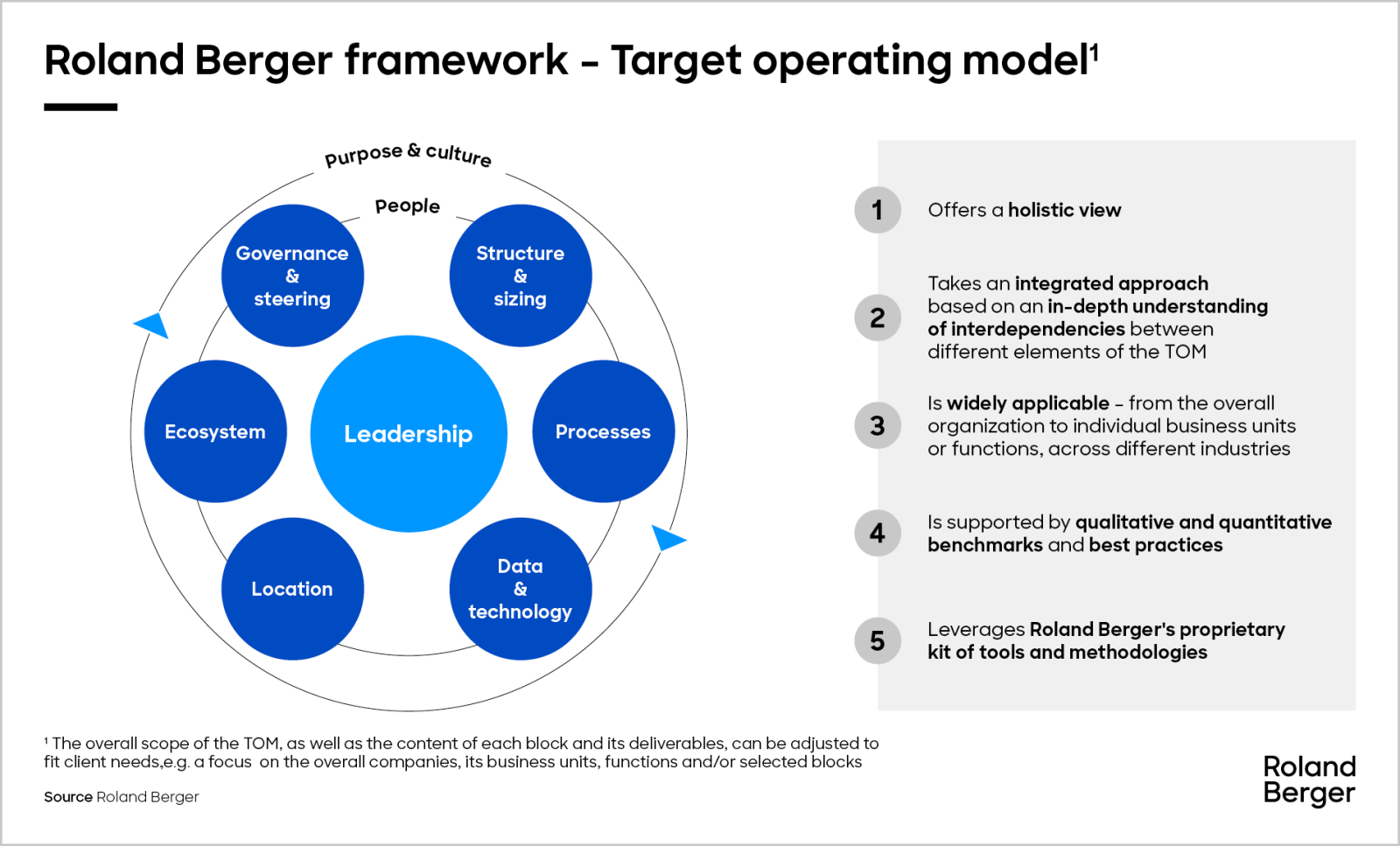
How we help companies refine their organization
Our approach to creating target operating models follows four steps:
- Design the top-down blueprint and set targets
- Validate the blueprint and targets bottom-up
- Develop an implementation and communication plan for all stakeholders
- Drive the organizational transformation and ensure ongoing monitoring
Within this framework, we consider all operating model dimensions, including purpose and culture, processes, governance, systems and technology, people and talent, and structure and dimensioning. No one-size-fits-all solution exists, however; each model must be tailored, coherent and rooted in the company’s strategy rather than its legacy. With this in mind, we ensure that every TOM is co-designed and tested with the employees.
The operating model is a core driver of value. It enables a company to deliver on its purpose, navigate a changing business environment, hit its KPIs and – most importantly – translate strategy into measurable performance.
Success stories
Register now to receive insights on People and Organizations and discover how to create a future-proof, high-performing organization that thrives on agility, resilience, and turning today’s disruptions into tomorrow’s opportunities.


