

A look at the market, use cases, risks and opportunities for players in the maritime ecosystem.


Autonomous Shipping Industry Survey 2026
Sea change: Autonomous shipping shifts focus from technology development to ecosystem execution
Our latest annual survey finds that the autonomous shipbuilding industry is entering a new phase – with its technological ambitions largely achieved, the challenge now is ensuring the wider ecosystem is ready for deployment. We look at the implications for the industry and provide recommendations for stakeholders to ensure they don’t get left behind.
"The question is shifting from whether autonomy will reshape shipping to where it creates real value – and which players move early enough to secure their position."

The global shipbuilding industry believes the technology for fully autonomous ships is now proven – but that the sector is not yet ready to deploy it, according to Roland Berger’s Autonomous Shipping Industry Survey 2026. Its findings reveal a shift in thinking compared to 2025, with confidence in the long-term role of autonomous ships rising strongly, but realism sinking in about the tricky path to commercialization. The results imply that success now depends less on technological development and more on identifying areas where autonomy creates value, pinpointing scalable applications and readying the maritime ecosystem to support deployment.
Key findings
The survey, conducted among leading global shipbuilders, suppliers, infrastructure providers and other major industry players in the commercial and naval sectors, made five key findings:
Ambition is increasing: Full autonomy has overtaken remote-control technology as the industry’s prime focus, despite concerns over its rollout.
The value proposition is widening: The commercial focus shifted from crew-cost reduction toward efficiency and safety, while naval demand is increasingly for mission enhancement and swarming.
Bottlenecks are changing: Technology was the main constraint in 2025, but now regulation, standards, infrastructure and coordination are seen as the primary limitations.
Preferred use cases are emerging and investment is accelerating: Value is increasingly linked to selected use cases, while, despite uncertainty, R&D commitments have increased.
The center of gravity is shifting: Asia replaced Europe as the perceived frontrunner in autonomy, while confidence in meaningful adoption by 2035–2040 strengthened.
In this document we assess each of these shifts in detail, comparing the 2026 survey results with 2025 to highlight major changes and outlining the implications. We end with a series of recommendations for all stakeholders in the shipbuilding industry to navigate the changes and develop a successful autonomous shipping strategy.
The five shifts: Analysis and implications
Ambition is moving from remote-control technology toward full autonomy
In 2025, our survey respondents predominantly described autonomy through remote operation and human-in-the-loop models. Just 29% understood it to mean ‘Full autonomous’ while in 2026 this figure doubled. It’s clear the discussion has therefore shifted from "how humans control autonomous vessels" to "how autonomous vessels operate without humans".
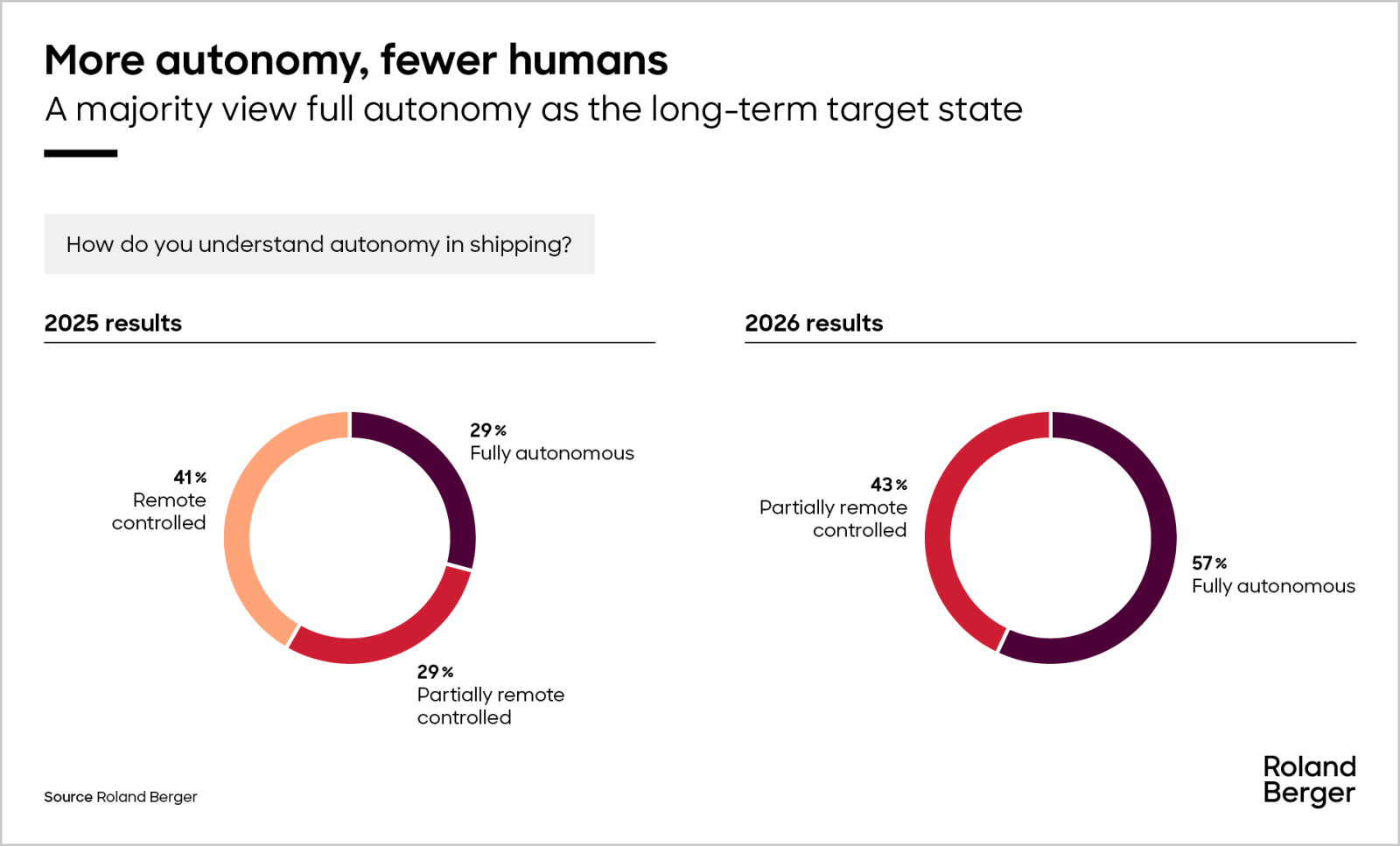
This indicates a more ambitious industry vision. But it does not imply that fully autonomous operation will immediately become the dominant model. The market is likely to progress through intermediate stages combining onboard automation, remote supervision and increasingly autonomous decision-making.
The value proposition is becoming broader and more differentiated
The view on the benefits of autonomous shipping has widened across both the commercial and naval sectors. In 2025, autonomy in commercial shipping was primarily viewed as a tool for reducing crew requirements and operating costs, with efficiency gains driving the business case. But today respondents place greater emphasis on fuel efficiency and navigation, suggesting a broader view of autonomy as an enabler of operational performance.
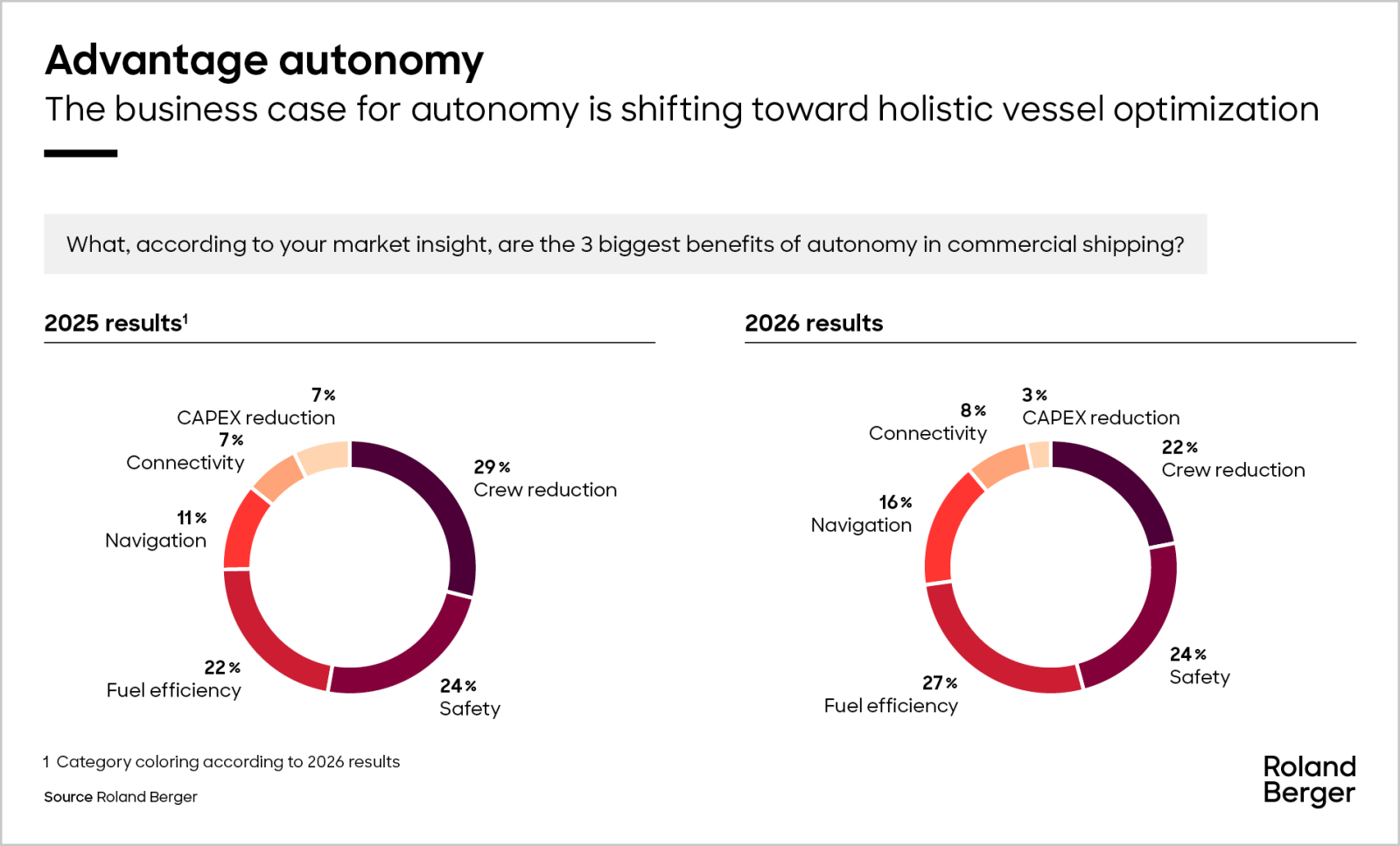
In the naval sector, the logic is different. In 2025, respondents already viewed autonomy primarily as a means of enhancing mission effectiveness, with value driven more by capability than cost reduction. This focus strengthened in 2026, while swarming also received a boost, from 15% to 24% of respondents selecting it as a benefit of autonomy. Both were buoyed by lessons learnt from the war in Ukraine, where unmanned maritime systems have demonstrated new ways of conducting naval operations. Autonomy is therefore increasingly regarded as a force multiplier that can enhance mission effectiveness, enable swarming and support new concepts of operations, rather than a means to reduce manpower.
"Autonomous shipping is no longer primarily a technology challenge. The winners will be those who can turn vessels, ports, regulation and operations into one scalable ecosystem."

Commercialization is being constrained by the ecosystem
Market penetration continues to fall short of industry expectations. The proportion of respondents citing market penetration as below their expectations jumped from 44% in 2025 to 64% in 2026, suggesting that commercial deployment is not keeping pace with technological progress.
While our respondents say that components such as sensors, navigation software and control systems remain essential to enabling autonomy (there was little change between 2025 and 2026), it’s becoming clear that the most significant barriers increasingly lie in the wider autonomy ecosystem. Concerns about regulation, insurance and technology standards – all critical to successfully scale operations – grew between 2025 and 2026, for example. This underlines the growing belief that while the ecosystem is key to market penetration, it is not yet fit for purpose.
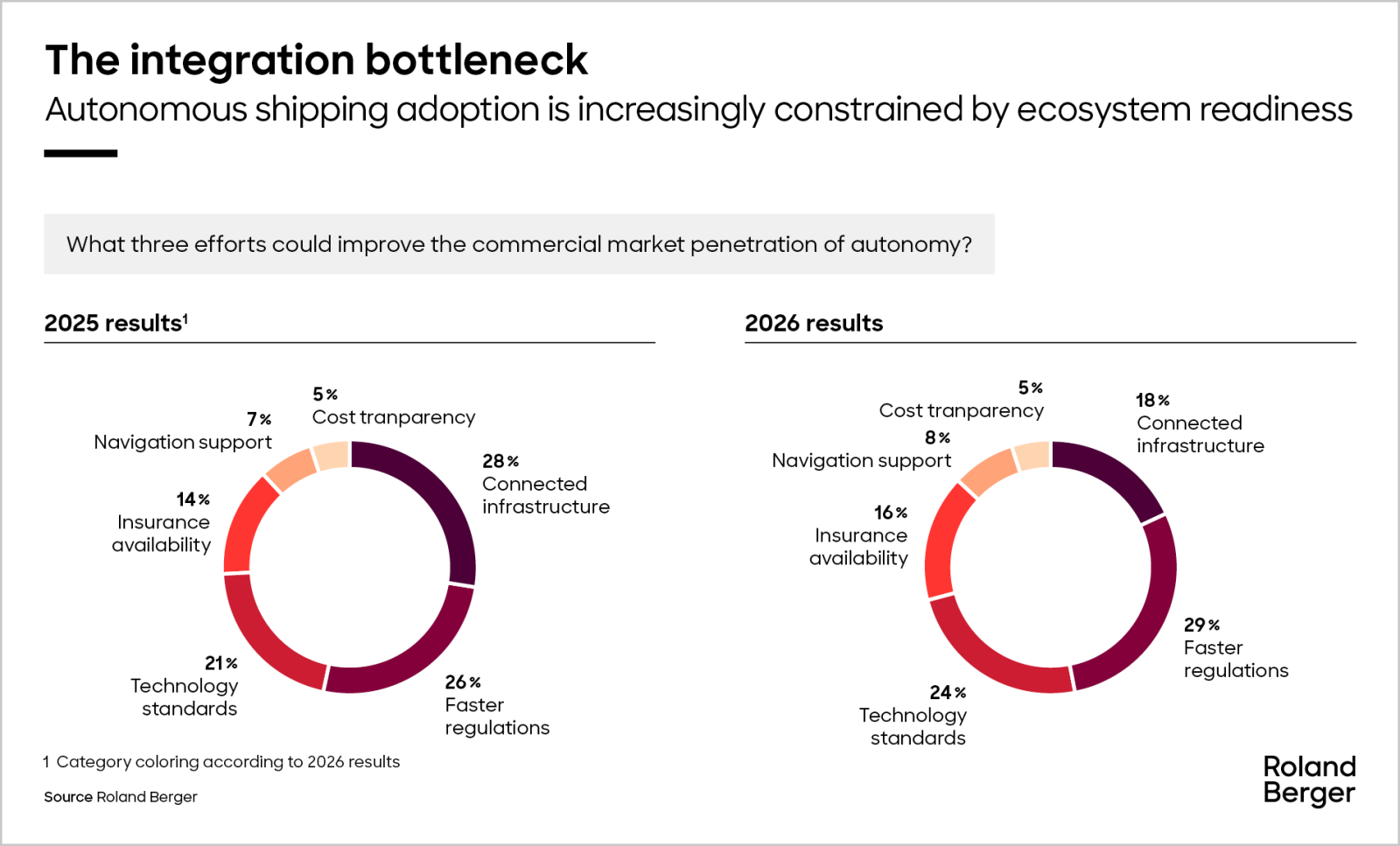
Common interfaces and clearly allocated responsibilities will be key to readying the ecosystem. This includes defining how vessels interact with ports, remote-operation centers and other traffic, and how responsibility is transferred between people and autonomous systems.
Use cases are becoming more selected and investment is increasing
In 2025, our survey showed that the market was considering a broad range of potential applications for autonomous ships. Today, however, it is coalescing around use cases with predictable routes, repetitive operations and clear economic or operational benefits, indicating a shift from experimentation to commercialization. Three stand out as particularly relevant - ferries, cargo transport and patrol applications, while offshore infrastructure support seems to have slipped off the radar.
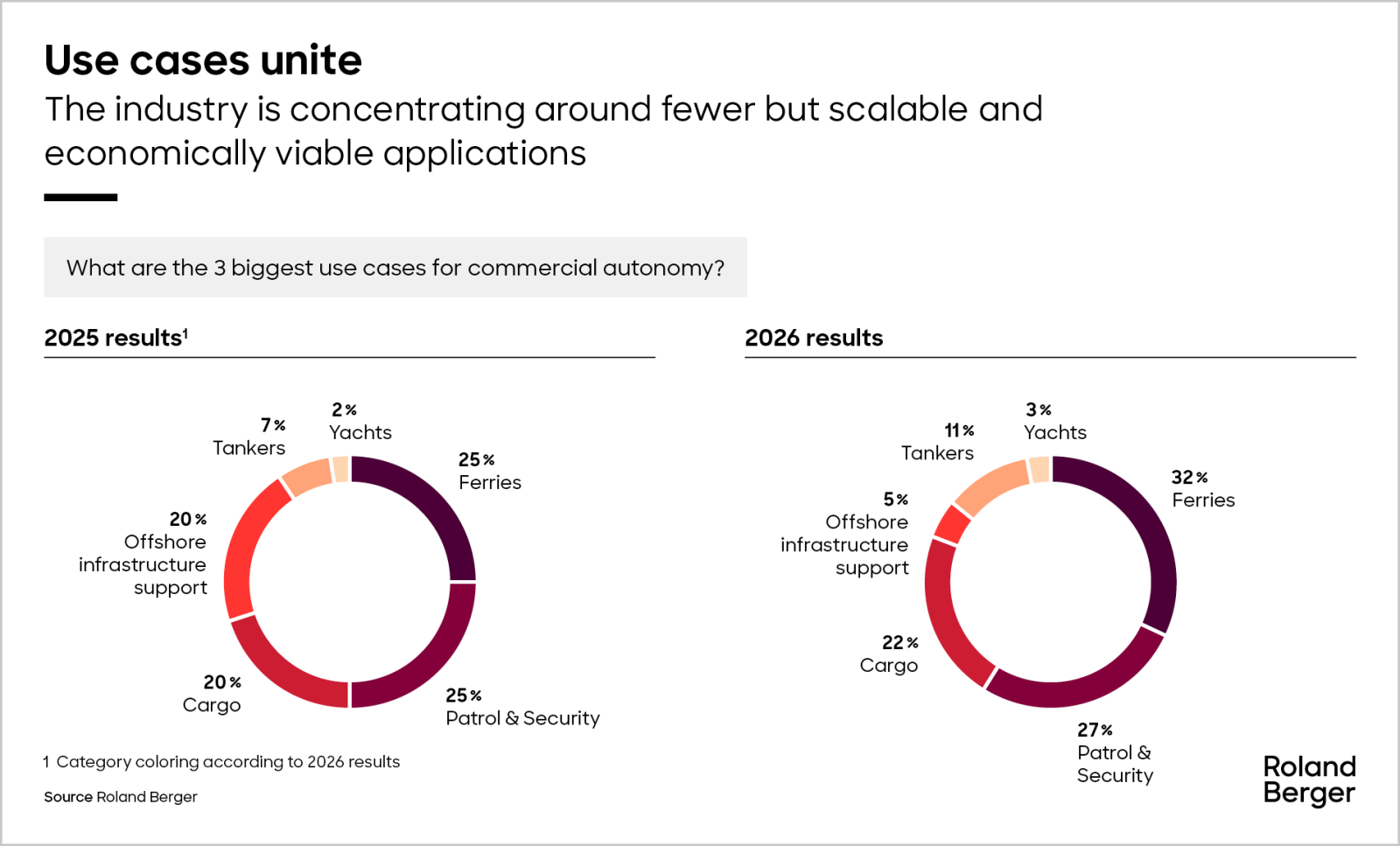
The attractiveness of individual use cases will, however, vary according to their specific requirements. Route complexity, operating environment, vessel type, infrastructure availability and the cost of alternative operating models could all play a role in whether they are successful or not. The next phase of development should therefore emphasize focused deployment rather than broad experimentation. This means selecting use cases with a credible path from pilot to repeatable commercial application.
Meanwhile, companies appear increasingly willing to commit meaningful R&D funds despite continued uncertainty around the pace of commercial deployment. The proportion of respondents whose firms are committing more than 10% of R&D budgets to autonomy jumped from 34% in 2025 to 71% in 2026. At the same time, expectations regarding near-term OPEX savings are becoming more conservative as the industry develops a better understanding of the costs associated with remote operations, infrastructure and system integration. Expectations of >5% savings fell from 38% to 29% between 2025 and 2026, for example.
Long-term confidence is rising as regional leadership shifts
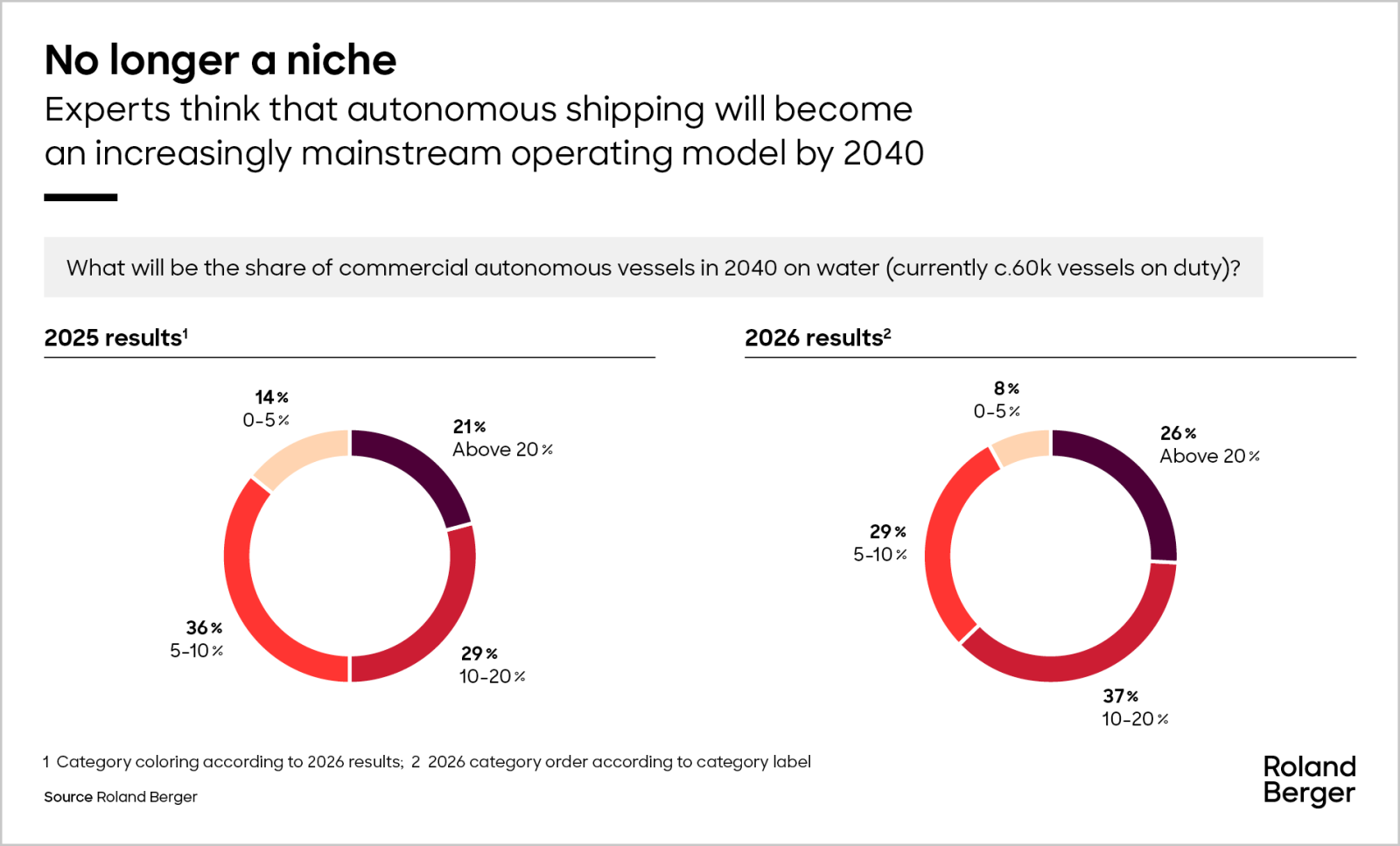
The survey results suggest the industry increasingly views autonomous vessels as a future mainstream operating model. For example, the proportion of respondents that thought the share of commercial autonomous vessels on the water in 2040 will exceed 10% rose from 50% in 2025 to 63% in 2026. This implies that while it is still unclear which operating models will prevail, the industry believes that regulatory and technological barriers will be overcome.
At the same time, Asia has overtaken Europe as the perceived future center of gravity for autonomous shipping. A majority (77%) of respondents cited Asia as the frontrunner in 2026, compared to 56% citing Europe in 2025. A key reason is that Asia, with its shipbuilding scale, speed of technology deployment and broader experience with autonomous technology, is increasingly viewed as the leader in the end-to-end autonomy ecosystem. It has the breadth of capabilities to pilot new technologies and then scale them due to its large shipyards. Europe, on the other hand, while retaining strong capabilities in maritime technology and regulation, risks losing momentum if implementation remains fragmented.
Recommendations for stakeholders
With the landscape having clearly shifted since 2025, maritime players need to rethink their autonomous shipbuilding strategies. Below we outline key focus areas for each stakeholder group.
Suppliers: Secure defensible positions in the autonomy stack, ensure interoperability and demonstrate customer value through real applications.
Shipbuilders: Develop modular, autonomy-ready architectures that support progressive capability upgrades.
Operators: Prioritize scalable use cases and assess total economics, including shore-based operations and infrastructure.
Regulators: Enable controlled deployment through test corridors and harmonized rules for certification, liability and cybersecurity.
Infrastructure providers: Standardize vessel–port interfaces and prepare connectivity, remote-operation and docking capabilities.
Maritime service providers: Prepare for smaller onboard crews and develop shore-based, digital and data-enabled offerings.
Naval stakeholders: Translate autonomy into mission-specific concepts of operations and evaluate dual-use potential.
Navigation providers: Evolve toward interoperable decision and supervision systems with clear handover protocols.
How Roland Berger can help
Thanks to our substantial experience in the shipbuilding and autonomous technology industries, we can help maritime organizations translate uncertainty around autonomy into focused strategic and investment decisions – and ensure they create value. Our support is comprehensive and includes:
- Market and scenario assessment - evaluating adoption pathways, regional dynamics and implications for the maritime value chain.
- Use-case prioritization - comparing applications based on customer value, technical feasibility, scalability and ecosystem readiness.
- Business-case development - assessing total economics across CAPEX, OPEX, remote operations and infrastructure requirements.
- Portfolio and partnership strategy - defining where to compete, which capabilities to build and which ecosystem partners are required.
- Implementation roadmaps – translating strategic priorities into sequenced pilots, capability development and investment milestones.
For more information, please contact one of our experts. We look forward to hearing from you.
About the survey
We spoke to numerous shipbuilding industry players from Europe, Asia and other regions working in the area of autonomy. These included suppliers (57%), shipbuilders (14%), infrastructure providers (21%) and shipping operators (7%). Their backgrounds were a mixture of commercial, naval and dual-use focus. Interviews were conducted at the Electric and Hybrid Marine World Expo 2026 in Amsterdam.
Sign up for our newsletter
Further readings


_person_320.png?v=1966195)


