

Discover how manufacturers can build autonomous operations to address labor scarcity. Learn strategic levers for lights-out factories through AI and process stabilization.


Physical AI: The next competitive advantage for manufacturers
By Bernhard Langefeld and Jonas Zinn
Manufacturers face structural pressures that only Physical AI can directly address
Physical AI extends artificial intelligence into the physical world, enabling machines to perceive, decide, and act – not just process information. Where generative AI has reshaped knowledge-intensive work, Physical AI is set to transform manufacturing and logistics: two functions whose physical nature has, until now, limited the reach of AI breakthroughs. But Physical AI is not one homogeneous technology. It encompasses multiple archetypes at different stages of maturity, each with their own supplier landscape and strategic logic. Realizing its full potential requires a strategy that integrates use cases, IT/OT architecture, and operating model into a coherent program.

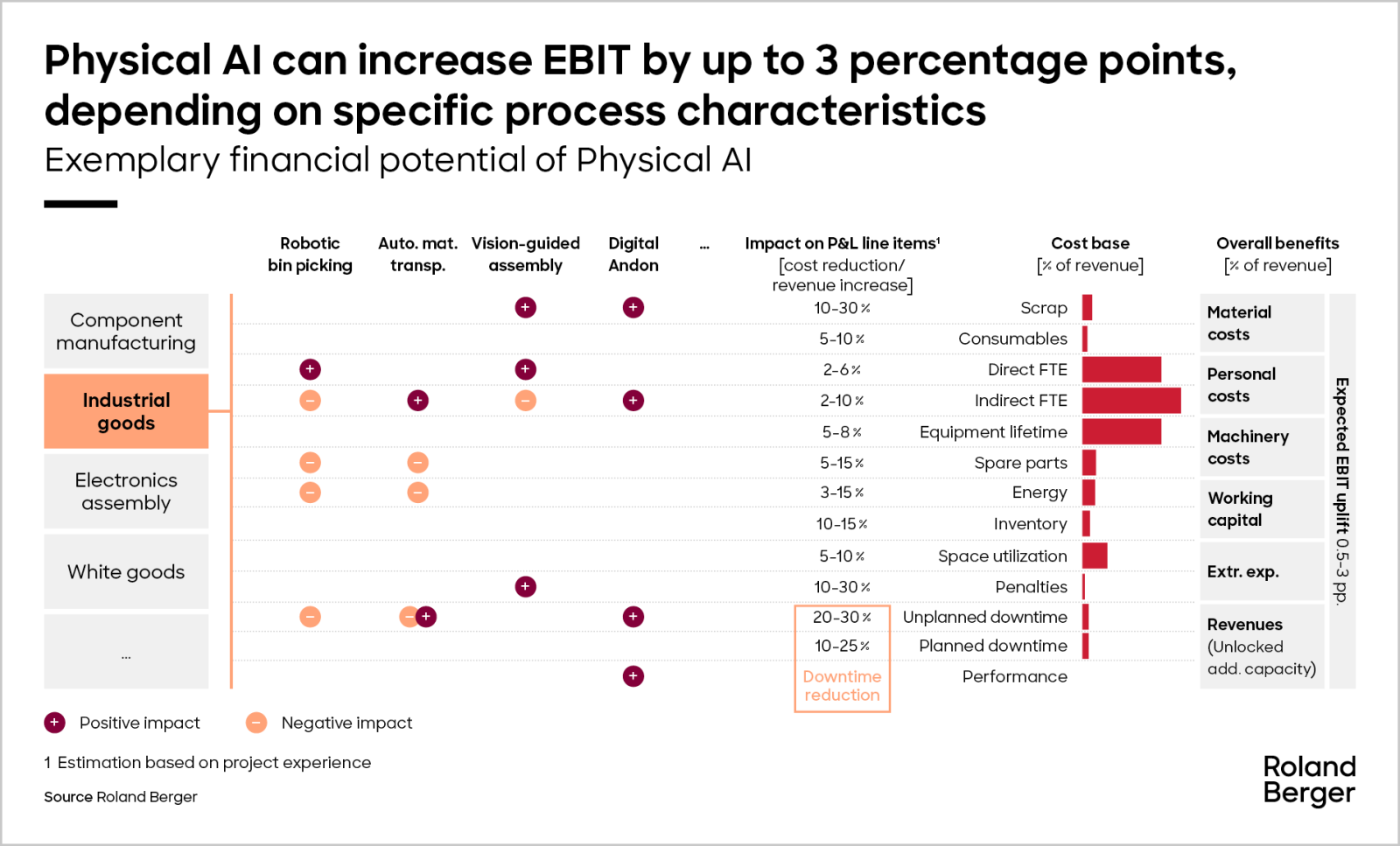
Physical AI at a glance: A coordinated portfolio of Physical AI use cases can already deliver an estimated EBIT uplift of 0.5 to 3 percentage points, depending on process and baseline performance.
"Physical AI turns data into action. The challenge is connecting the right use cases and operating model."

Why Physical AI is gaining urgency now
Three converging pressures are making the case for Physical AI more compelling across industrial sectors. Aging populations in major manufacturing economies are reducing the available pool of skilled industrial workers – from welders and machine operators to maintenance technicians. While Germany is anticipating a decline of -16% through 2050, China is expected to face a decline of -24%. At the same time, many industrial environments continue to expose workers to avoidable physical risk, from power plants and oil and gas platforms to confined spaces and damaged infrastructure. And persistent operational inefficiencies – unplanned downtime, defects detected too late, unnecessary maintenance cycles, and rework – remain a significant drag on margins.
What has changed is the commercial maturity of technologies that can directly address these challenges. Autonomous mobile robots, AI-enabled vision systems, and advanced manufacturing operations software have moved from experimental deployments to production-scale applications. Based on Roland Berger project experience, a coordinated portfolio of Physical AI use cases can already deliver an estimated EBIT uplift of approximately 0.5 to 3 percentage points – driven by reduced labor costs (-10%), lower scrap (-10–30%), better equipment utilization (+10–30%), and improved quality control. The question for manufacturers is no longer whether to engage with Physical AI, but where to start – and how to scale effectively.
A landscape defined by four distinct archetypes
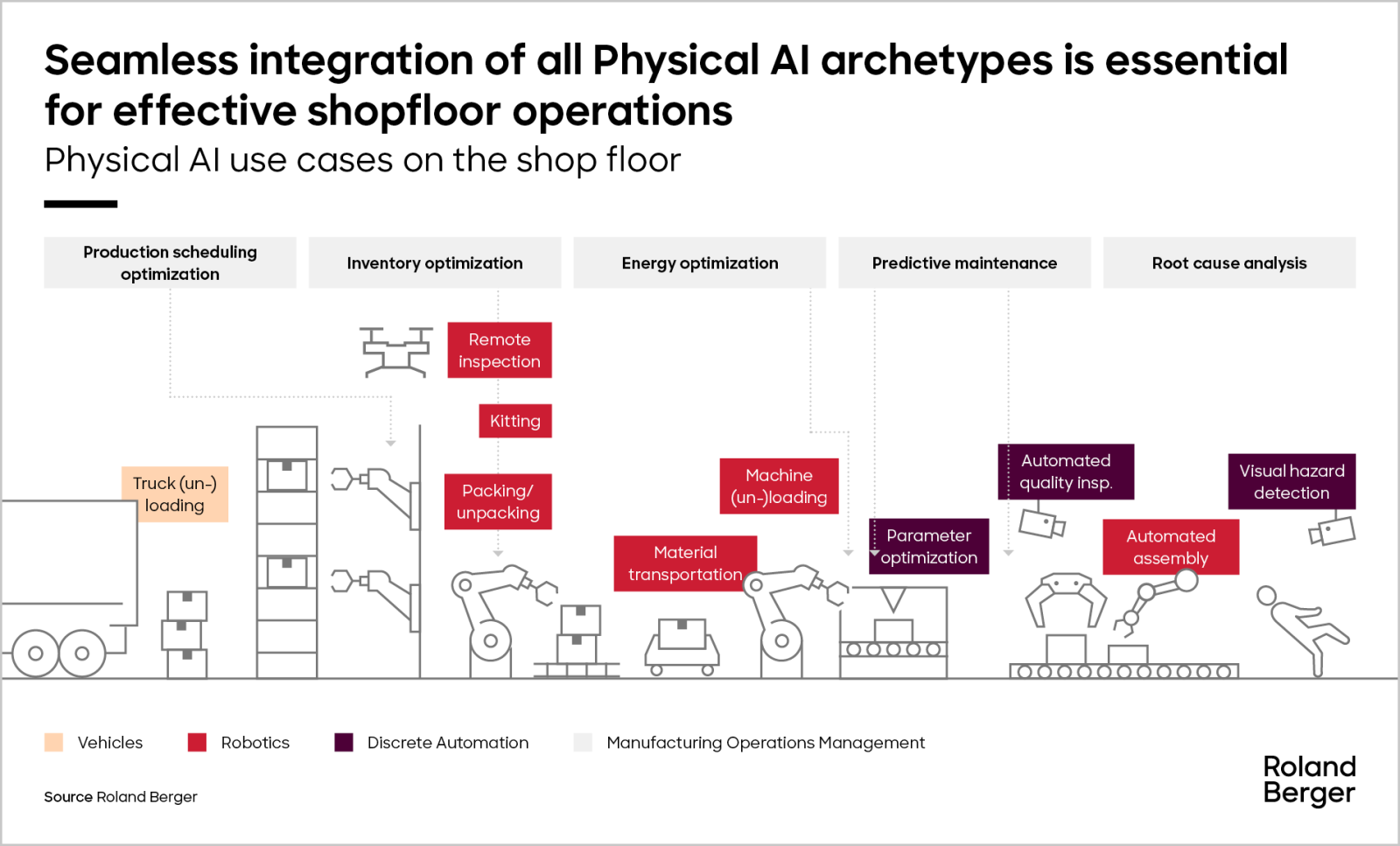
Physical AI is not a single technology category. It encompasses four distinct archetypes, each with a different maturity level, supplier ecosystem, and set of strategic decisions:
- Intelligent robotics covers stationary, mobile, and humanoid platforms that handle and manipulate parts, enabling machines to handle product and environmental variances that traditional fixed automation cannot accommodate.
- Autonomous vehicles – including automated mobile robots, and drones – support material transport and distributed inspection, including in hazardous or hard-to-reach locations.
- AI-enabled discrete automation leverages machine vision and timeseries analytics directly at production line controllers, enabling quality inspection, process parameter optimization, and defect detection at the point of origin.
- Intelligent manufacturing operations management connects intelligence across the factory, supporting production scheduling, energy optimization, and root cause analysis at plant level.
Each archetype requires a different approach. Some applications – including automated visual quality inspection and robotic asset inspection – are commercially mature and delivering measurable returns today. Others, including humanoid platforms for parts handling or assembly automation, are developing rapidly but require a longer horizon. A roadmap built on a single make-or-buy rule or a uniform deployment model will not capture the full potential across all four archetypes.
From isolated pilots to an intelligent shop floor
Individual Physical AI applications can generate meaningful value. The full potential, however, only emerges when these archetypes work together across the shop floor. A connected architecture – linking operational technology, manufacturing systems, and enterprise applications – creates the foundation for a production environment that learns, adapts, and improves continuously.
This integration challenge is among the most consequential decisions manufacturers will face. It involves choices about data infrastructure, IT/OT connectivity, vendor selection, and internal capability. It also requires clear governance: who owns each technology layer, who maintains it, and how it scales from one plant to the next. A robot cannot be treated as simply another piece of equipment, and an AI inspection model cannot remain a stand-alone pilot if the goal is system-level performance improvement. Our latest study on lights-out manufacturing details how to successfully combine these technologies to move closer to the vision of the fully autonomous factory.
Humanoid robots attract considerable attention, and their development potential is real. But manufacturers should not wait for a general-purpose humanoid before acting. Selected intelligent robotics use cases combined with mature vision systems, mobile inspection platforms and predictive maintenance applications can create measurable value today – and building the operational and technical foundation now positions companies to adopt more advanced capabilities as they mature.
A structured path from ambition to execution
We believe that a successful Physical AI strategy connects use cases, technology architecture, and operating model in a single integrated program. This begins with a structured baseline assessment across the production network – mapping operational performance at process step level, evaluating the existing IT/OT landscape, and identifying data availability and quality. From this foundation, use cases are prioritized not by technological novelty, but by process value and financial and non-financial impact.
"The manufacturers that lead will treat Physical AI as an operational transformation, not a technology experiment."

Prioritized use cases then inform the target IT/OT architecture, including data, interface, and deployment requirements. Building the required operating model – spanning operational experts, automation engineers, IT/OT architects, cybersecurity specialists, and change leaders – is an equally critical step. The result is an integrated roadmap that turns a collection of pilots into an executable transformation program with clear milestones, defined capital requirements, and measurable outcomes.
Physical AI is moving from the digital workspace into the factory. The manufacturers that lead will be those who treat it as an operational transformation rather than a technology experiment – selecting use cases based on process value, building scalable technical foundations, and preparing their organizations to work alongside intelligent machines. The full analysis sets out each archetype in detail, examines the integration challenge, and provides the frameworks needed to build and execute a Physical AI strategy.
FAQ section
Sign up for our newsletter
Further readings


