


Strategic workforce planning
Build exceptional teams that meet tomorrow’s skill requirements
Deepening imbalances between workforce supply and demand, amplified by major business and technology shifts, are transforming skill requirements across industries. Major economies such as those of China, Japan and parts of Europe must offset a steep decline in their working-age populations, while organizations simultaneously contend with escalating cyber threats, climate-driven disruptions, rapid job redesign, regulatory change and accelerating technological innovation. Each of these factors can dramatically reshape how work is performed.

As industries evolve, entirely new roles and skill sets are emerging, making proactive, AI-driven workforce management essential. Changes will be felt across all sectors and professions. The half-life of skills, for instance, is shrinking from four or five years to just 12 to 18 months, while 60% of today’s students will enter jobs that do not yet exist. At the same time, rapid job hybridization is creating demand for new skill combinations.
Addressing labor shortages and skill shifts requires a fresh approach to workforce and talent management that goes beyond traditional human resources (HR) reporting and short-term staffing decisions. To navigate these changes effectively, we believe that organizations must focus on five key fields of action: upskilling, staffing, streamlining, hiring and performance.
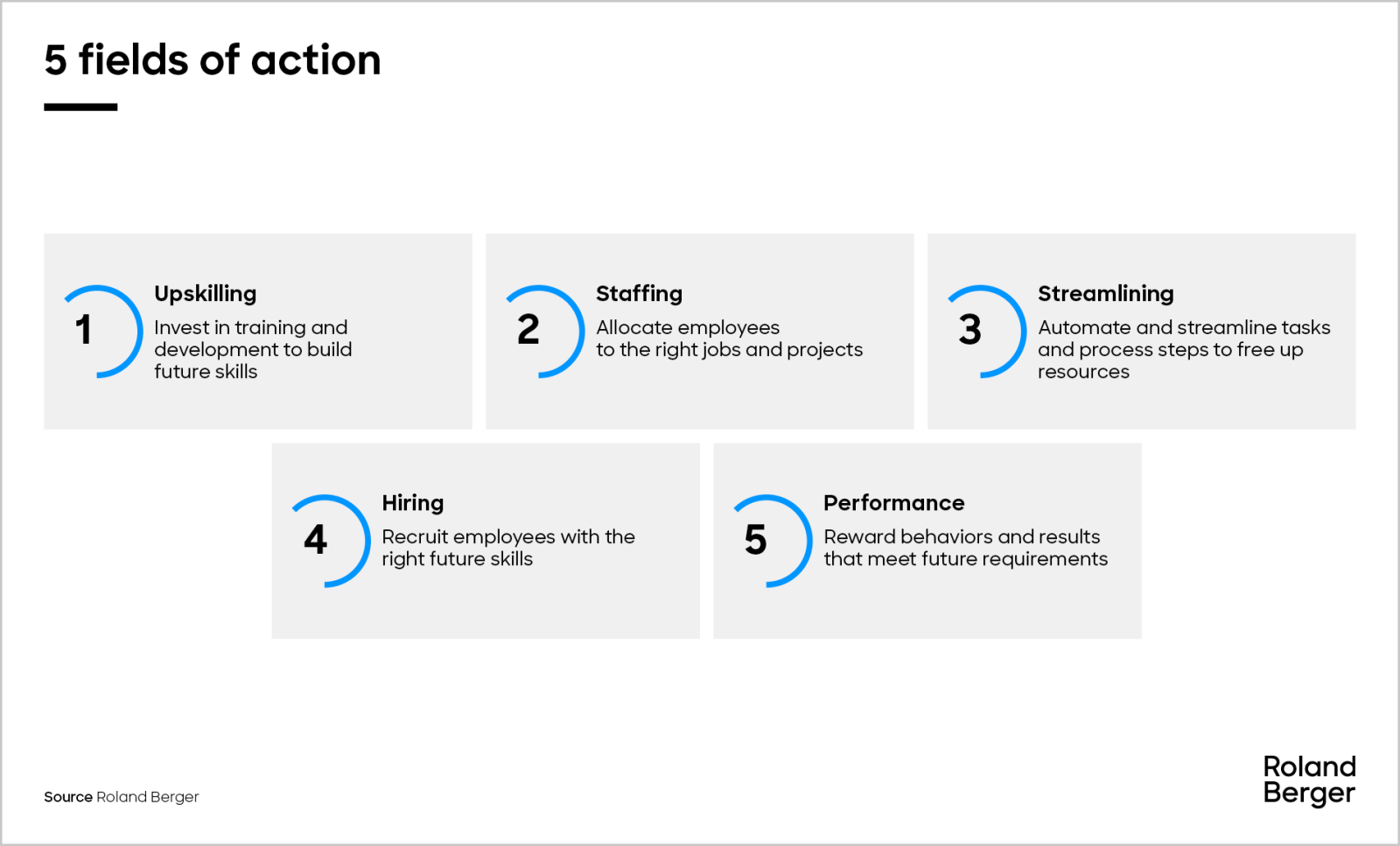
Strategic workforce planning (SWP) ties all these elements together, enabling organizations to translate strategy into long-term workforce decisions and adapt to the rapid changes taking place in the world of work. Workforce planning provides a structured way to understand, plan and manage an organization’s workforce over time. At its core, it brings together data on roles, skills, capacities and headcount with insights on recruitment, retention and productivity to support informed people decisions. Strategic workforce planning (SWP) builds on this foundation by explicitly linking workforce decisions to business objectives and long-term strategy. It enables organizations to anticipate future workforce demand, identify gaps early and define targeted measures to close them – ensuring the workforce evolves in line with changing business needs.
Matching workforce supply and demand
"Strategic workforce planning is essential for understanding current workforce supply and anticipating future skill demand."

SWP is essential for understanding current workforce supply and anticipating future demand, enabling precise and informed decisions. It ensures the right person is in the right role at the right time and in the right capacity, thereby optimizing workforce efficiency and headcount allocation.
SWP delivers a number of additional benefits. It establishes a unified language for effective communication and decision-making across business and HR. It enhances transparency over employees’ roles and skill sets. It identifies tasks that can be automated to improve efficiency. And it helps define future workforce demands based on business and people strategies while creating a clear roadmap for action across recruitment, retention and workforce transformation.
Roland Berger’s proven approach to strategic workforce planning
Our SWP solution follows a three-step approach: analyze workforce supply, determine workforce demand, and then use this information to identify the gap and derive actions to close it. This approach integrates qualitative insights with advanced analytics to support robust decision-making.

We have also created an AI-driven SWP engine that enables users to produce precise outputs for SWP, strengthen workforce reporting and generate actionable recommendations for immediate implementation across business and HR functions.

Advancing the workforce
Businesses benefit from this approach in four key areas:
- Anticipating future roles and skills demand: By establishing a sustainable, pragmatic workforce planning mechanism, organizations can identify future jobs, assess the external talent market and adjust skill sets accordingly. We help you develop workforce scenarios based on differing projections, identify gaps in the workforce and draw up appropriate action plans aligned with your business objectives
- Benchmarking workforce capabilities: We provide you with access to the world’s largest and smartest labor market database, allowing you to choose from more than 5,000 market profiles and a global list of companies as a basis for comparing workforce capabilities
- Assessing external and internal talent mobility: We help you understand the availability of external talent and internal employee mobility, as a basis for filling vacancies or skill gaps. This supports effective recruitment and retention
- Upskilling your workforce to meet future needs: We help you develop upskilling programs to close the gap between the current and optimal workforces, establishing career paths and learning measures to support sustainable, long-term workforce development
Success stories
Register now to receive insights on People and Organizations and discover how to create a future-proof, high-performing organization that thrives on agility, resilience, and turning today’s disruptions into tomorrow’s opportunities.


