

Boosting resilience across the shipbuilding sector

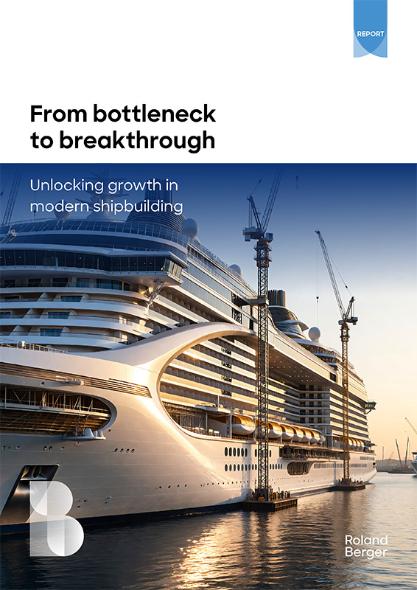
From bottleneck to breakthrough in modern shipbuilding
Why production capacity - not sales - is now the critical constraint for shipbuilding growth
The global maritime industry is at an inflection point. Naval rearmament, accelerating green regulation, record cruise-ship demand, and portfolio diversification are converging to reshape the competitive landscape. Yet amid this opportunity lies a fundamental challenge: for the first time in decades, production capacity - not order acquisition - has become the critical bottleneck. Shipyards that fail to actively mitigate this constraint will struggle to capitalize on strong market fundamentals. Those that do will unlock their next phase of growth.

The perfect storm reshaping shipbuilding
The pressures are mounting from multiple directions. Geopolitical tensions have surged demand for naval vessels, tying up years of specialized capacity at yards like ThyssenKrupp Marine Systems and Huntington Ingalls. Meanwhile, the cruise industry's post-pandemic rebound has pushed high-end shipyards into the 2030s with booked-out order books. Simultaneously, tightening International Maritime Organization regulations and ambitious corporate ESG targets are making low-emission propulsion systems non-negotiable—raising technical complexity and demanding closer supplier collaboration. This convergence is creating persistent capacity tightness across the entire value chain, from specialized outfitters to propulsion suppliers.

"If your key propulsion supplier has a two year backlog, your contract with the shipowner is worth exactly as much as that supplier decides it is."

The result? Lead times are extending. Bargaining power is shifting decisively toward suppliers. Shipyards are facing stricter contractual terms and shrinking flexibility. For those relying on single-source suppliers, the risk is acute.
Redefining production and procurement roles
These market dynamics demand a fundamental rethinking of how shipyards operate. Production can no longer be simply steward of steel construction - that baseline excellence is now table stakes. The real value-add lies in orchestrating complex system integration across hundreds of internal and external partners. Similarly, procurement must evolve from a transactional ordering function into a strategic function that actively shapes supplier portfolios, secures critical capacities, and fosters long-term innovation partnerships.
We believe this requires a clear shift in operating models. Production must become a sophisticated integrator managing multiple suppliers while maintaining end-to-end visibility across the entire value chain. Procurement must segment suppliers into strategic partners, capacity providers, and innovation collaborators—then manage each category with distinct governance and engagement models.
"Capacity constraints are not predetermined but can be actively mitigated by strategic decisions."

Strategic levers for unlocking capacity
Leading shipyards demonstrate that capacity constraints are not predetermined. They can be actively mitigated through deliberate strategic choices. We've identified five best practices that separate frontrunners from the rest: strengthening governance and cross-functional steering of major vessel programs; redesigning production footprint and make-or-buy strategy to identify what stays in-house versus what flows to partners or best-cost countries; building deep, long-term supplier partnerships around critical systems; moving to integrated, project-based ways of working that eliminate functional silos; and enabling end-to-end steering through advanced digital planning platforms.
"Steel bending is no longer your edge. Orchestrating 500 suppliers without blinking - that is."

The most powerful lever may be the last one. Fragmented tools and isolated planning have reached their limits. A unified digital platform creates a shared, live view of engineering, procurement , and production, replacing conflicting versions of the truth with one source of data. Such platforms enable integrated capacity planning, early identification of bottlenecks, and scenario-based decision-making supported by AI-driven forecasting. Planning shifts from a static annual exercise to continuous, data-driven steering.
The path forward for shipbuilding leaders
The capacity constraints facing shipyards today are real and persistent. Yet they need not be paralyzing. Yards that proactively redesign their production footprint, build resilient supplier ecosystems, and invest in integrated digital steering will outcompete those that simply accept constraints as fixed. The question is not whether capacity bottlenecks can be overcome - leading players are already demonstrating how. The question is whether your yard will move decisively to secure competitive advantage in this new era of maritime growth.
The full study explores each best practice in detail, providing concrete frameworks for transformation.
Request the full PDF here
Register now to access the full study. Furthermore, you get regular news and updates directly in your inbox.
Further readings


