

Shareholding-as-a-Service – A secured framework for carving out non-core business units for restructuring, liquidation or M&A purposes.


Private credit's first stress cycle
By Marcus Wolf and Leonard Schwellnus
How operational execution will determine recoveries
Private credit – corporate lending provided by non-bank investors rather than traditional banks – is entering its first significant stress cycle since it became a major source of corporate financing. While the number of actual defaults remains low, pressure is building across private credit portfolios as higher interest rates and weaker growth expose vulnerabilities. Financial restructuring can buy time, but how much value investors ultimately preserve will depend on how effectively the underlying businesses are stabilized and how well the turnaround is executed.
Private credit – corporate lending from non-bank investors – has become part of the European financing mainstream. It is now starting to experience its first significant stress cycle since becoming a major source of corporate financing. While the number of defaults is still low, pressure is building across private credit portfolios, caused by higher interest rates and weaker growth exposing vulnerabilities. Financial restructuring can buy a troubled company time. But how much investors ultimately recoup from a stressed investment (their "recovery") depends on the effectiveness of the measures taken to stabilize the underlying business and the quality of the turnaround execution.
"Navigating today's more fragmented creditor landscape requires both operational depth and a strong understanding of investor dynamics."
_person_144.png?v=1966195)
Private credit is reshaping the creditor landscape
In Europe, private credit has grown from a niche financing source into a major provider of capital for mid-sized and large companies, particularly those backed by private equity sponsors. Two factors in particular drove this development: banks became more selective because of tighter regulation and internal capital constraints, and companies needed flexible financing solutions that did not fit traditional bank processes or risk profiles.
The result is a new creditor landscape. European companies are now financed by a broader set of capital providers, from direct lenders, private credit funds, opportunistic credit investors, and hedge funds to collateralized loan obligation investors and bondholders. When a company comes under pressure, creditor groups are often more international and fragmented than in the past. Lenders may also take a more transactional approach, and their interests do not always align. As Roland Berger's 2025 Restructuring Survey shows, processes are taking longer and becoming more complex.
Low defaults do not mean low stress
Much of today's stress can be traced back to transactions originated between 2019 and 2021 – a period of cheap capital and intense competition that drove up valuations. These financings often combined elevated leverage with floating-rate exposure and were underwritten for continued growth. Lenders assumed rising revenues and margins. Attractive exit prospects were also part of the underwriting case.
The problem is that this environment no longer exists. Interest rates are materially higher, growth has slowed, margins are under pressure, and exit markets are more selective. Refinancing is more expensive and sometimes unavailable on acceptable terms. The issue is not private credit itself but the mismatch between those assumptions and today's operating reality. Higher interest costs reduce available cash, while slower growth exposes weak commercial assumptions. Working capital absorbs liquidity and capital expenditure becomes harder to fund.
At first glance, the cycle still looks manageable. Reported default rates remain relatively low and many funds report stable performance. But this picture is incomplete. Private credit is effective at avoiding defaults. Investors can engage privately and adjust structures quickly, preserving optionality. They can defer cash interest through payment-in-kind structures, extend maturities, reset covenants, provide additional liquidity, or negotiate bespoke solutions. As a result, many stressed situations remain below the surface. This is the iceberg effect in private credit: visible defaults are only the tip.
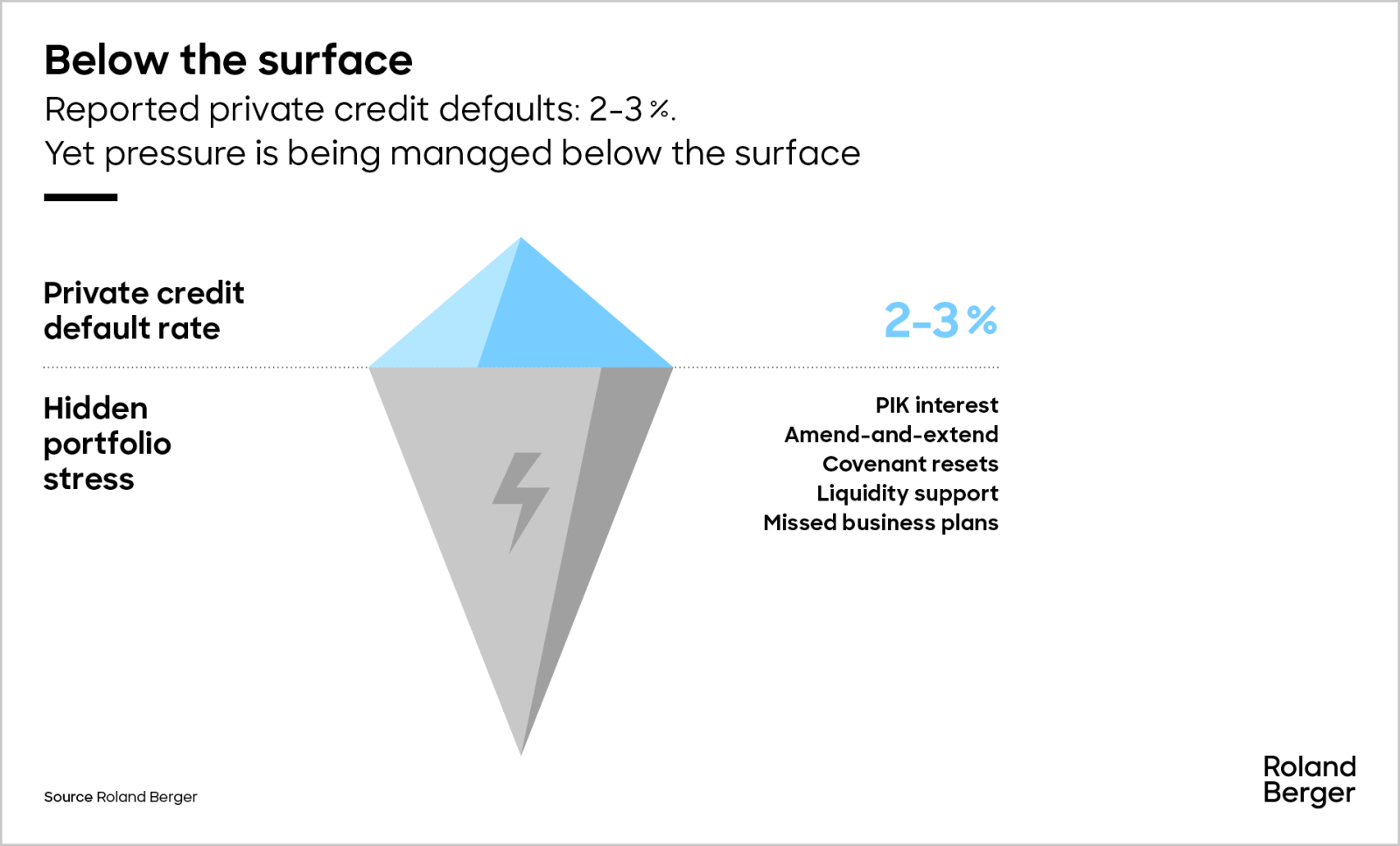
Buying time is not recovery
When a private credit-backed company comes under pressure, the first response is usually not a formal restructuring. Payment-in-kind (PIK) interest can protect short-term cash, while amend-and-extend transactions can push out maturities and reduce refinancing pressure. These tools can mean the difference between a disorderly process and a controlled stabilization. But they do not fix the business.
Financial restructuring buys time; operational restructuring determines whether that time produces a recovery. A company facing temporary liquidity pressure may recover if given enough runway, but one facing structural underperformance will not recover through additional runway alone. Relying on financial measures without addressing the operational root cause can reduce optionality and erode recoveries. The objective? To distinguish early between temporary liquidity pressure and structural underperformance.
From lender to owner – the "accidental owner" challenge
Where financial measures have bought time but the business still does not recover, the restructuring logic changes. Credit investors may find themselves becoming owners rather than lenders. A debt-to-equity swap can establish a more sustainable capital structure, but the operating business may still be under pressure. Taking the keys is not the end of the process – it is the beginning of the recovery challenge.
This is the "accidental owner" challenge: lenders may find themselves owning a troubled business they were never set up to run. Credit funds are built to originate loans, price risk, manage downside, and maximize recoveries. Owning and operating a stressed company is a different task altogether.
A three-step operational approach to lender-led recovery
For new owners, Step 1 is to establish transparency: a reliable and independent fact base. They may have known the company largely through a credit lens, but now what's needed is a clear view of its true operational and financial position. A Roland Berger independent business review or outside-in review can provide that picture, covering market dynamics, customer and product profitability, cost structure, working capital, and near-term liquidity. A business planning review can then test existing assumptions against operational reality. Creditor-oriented financial reporting provides the visibility needed to engage with the business on an informed basis.
Step 2 is to stabilize the business and prepare for recovery. A 13-week cashflow model and cash office can establish control over cash movements and identify near-term pressure points. The operational diagnosis then needs to be translated into an executable recovery plan. Roland Berger's holistic turnaround concept brings together the measures needed to make the business viable under its new ownership, from cost measures and commercial levers to procurement and footprint decisions.
The route to exit should be considered from the outset, particularly for credit investors whose investment horizon is shaped by fund life and return requirements. Strategic options can range from operational turnaround to sale preparation and selected disposals. Exit readiness is not a downstream consideration but a design parameter that shapes decisions from day one.
Step 3 is to drive execution and provide interim support. This is where many lender-led situations falter. New owners are often not set up to lead operational implementation directly, while the existing management team may lack the capacity or authority to execute a turnaround under pressure. A structured project management office can establish clear responsibility for implementation and maintain momentum. Where management capacity is insufficient, interim management can stabilize critical leadership functions. Direct support for the Chief Financial Officer (CFO) may also be required. Where needed, a Chief Restructuring Officer (CRO) can maintain continuity and centralize accountability throughout the process.
What will determine value
We are confident that private credit will remain a core part of European corporate finance. But its first major period of stress will demand capabilities different from those required during the growth years. Financial measures can give a company time and preserve its options, but what ultimately matters is what happens during that time. How much value investors are able to protect will depend on the quality of the operational recovery and how well the turnaround is executed.
Request the full PDF here
Sign up now to access the full study. You will also receive regular news and updates, delivered straight to your inbox.
Further readings


Senior Partner, Managing Director Ralf Schmitz CRO Management GmbH
Munich Office, Central Europe
+49 89 9230-8106


_person_320.png?v=1966195)
