

Explore how renewable energy project developers under pressure can achieve measurable results.
_background_w1280.jpg?v=1942131)

US renewable energy: Entering a consolidation cycle
The economics of renewable development increasingly favor scale
The US renewable energy development market is entering a new phase. From 2021 to 2024, developers grew fast: pipelines expanded, capital was abundant, and investors were willing to pay for future optionality. Today, queue reform, rising interconnection costs, longer timelines, and policy changes have made development more capital intensive, while AI driven power demand has raised the premium on operating assets and near-term commercial operation. Buyers now reward execution and balance sheet strength over pipeline size alone - leaving many independent developers, built for the old market's cost structure, facing a new wave of consolidation where scale is the deciding advantage.
Growth created opportunity, but also fragmentation
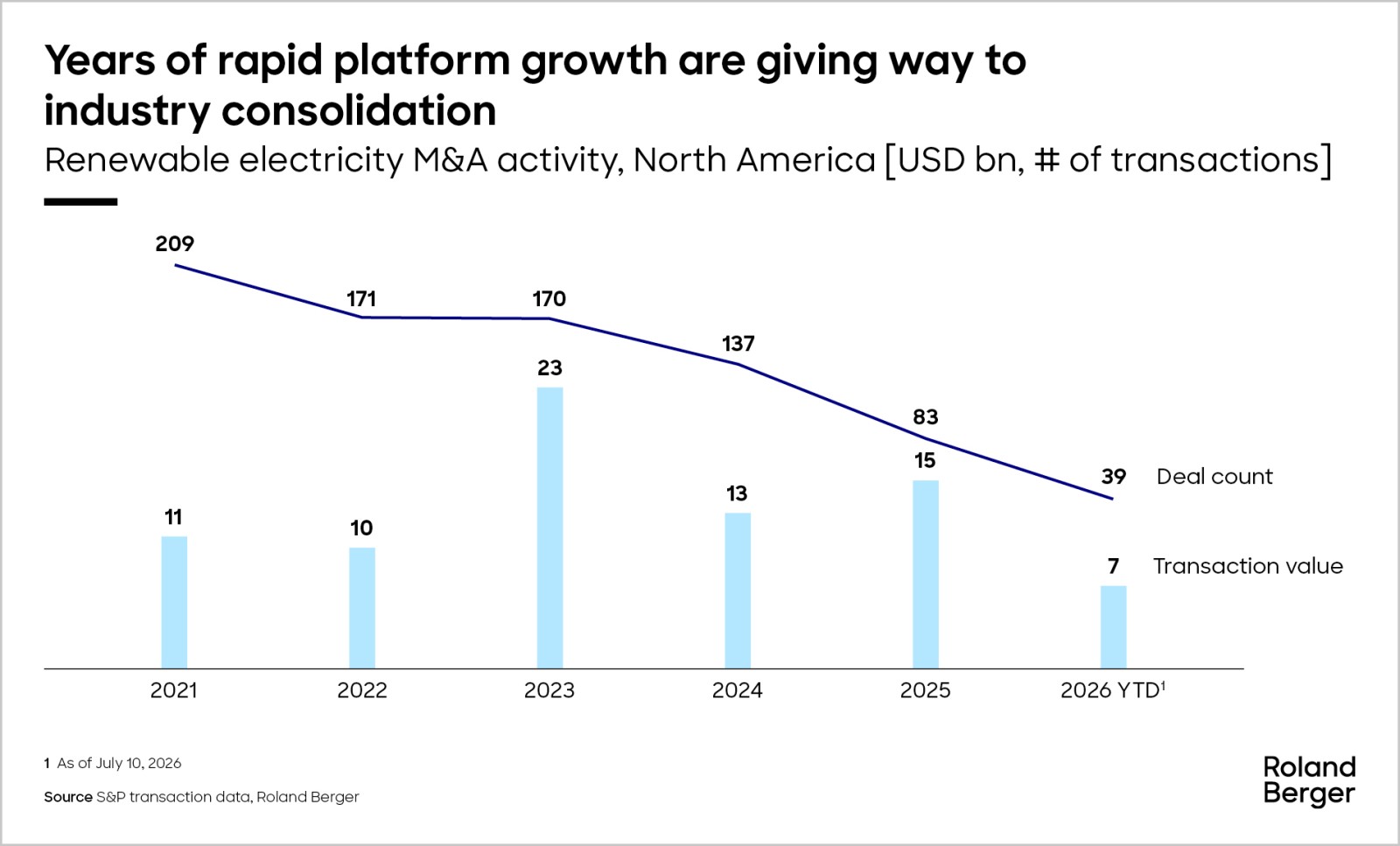
Between 2021 and 2024, the North American renewable sector experienced one of its strongest investment cycles, with ~700 transactions and USD 55 billion of disclosed deal value across 171 reported deals. Long term policy support, improving project economics and the Inflation Reduction Act attracted unprecedented levels of infrastructure and private equity capital.
Developers responded by expanding rapidly. Teams grew, pipelines increased and new platforms emerged across utility scale solar, battery storage and distributed energy resources. The develop-and-flip model thrived: with limited balance sheet, companies could monetize projects before construction and recycle capital into new development.
Importantly, the underlying market opportunity remains strong. The US is still expected to add 43.4 GW of utility scale solar in 2026, representing nearly half of all planned generation additions, while battery storage is set for another record year (EIA 2026). What has changed is not demand, but how investors value development platforms.
As capital became more abundant, pipeline size became a key driver of platform value. Investors were willing to assign meaningful value to projects years before construction, contributing to a highly fragmented market. Today, the US interconnection queue exceeds 2.6 TW of proposed generation and storage capacity, highlighting both the scale of development activity and increasing competition for transmission access (LBL 2026).
Policy shifts changed what investors value
The market began shifting following FERC's 2023 queue reform, which increased the capital required to develop utility scale renewable projects through larger interconnection deposits, stricter commercial readiness requirements and higher withdrawal penalties. Combined with rising interconnection costs and longer development timelines, these changes favored larger, better-capitalized developers.
The shift accelerated following changes to federal clean energy policy in 2025. The accelerated phase out of tax incentives for many future renewables projects changed development economics for assets that had not already secured eligibility through construction timing or safe harbor strategies. Across the industry, developers focused on preserving tax credit eligibility and protecting the value of existing pipelines, while many delayed new project origination.
Financing also became more challenging. With interest rates roughly 500 basis points above early 2022 levels, policy uncertainty and wider valuation expectations made capital raises and strategic sales increasingly difficult, particularly for smaller distributed generation platforms (FRED 2026).
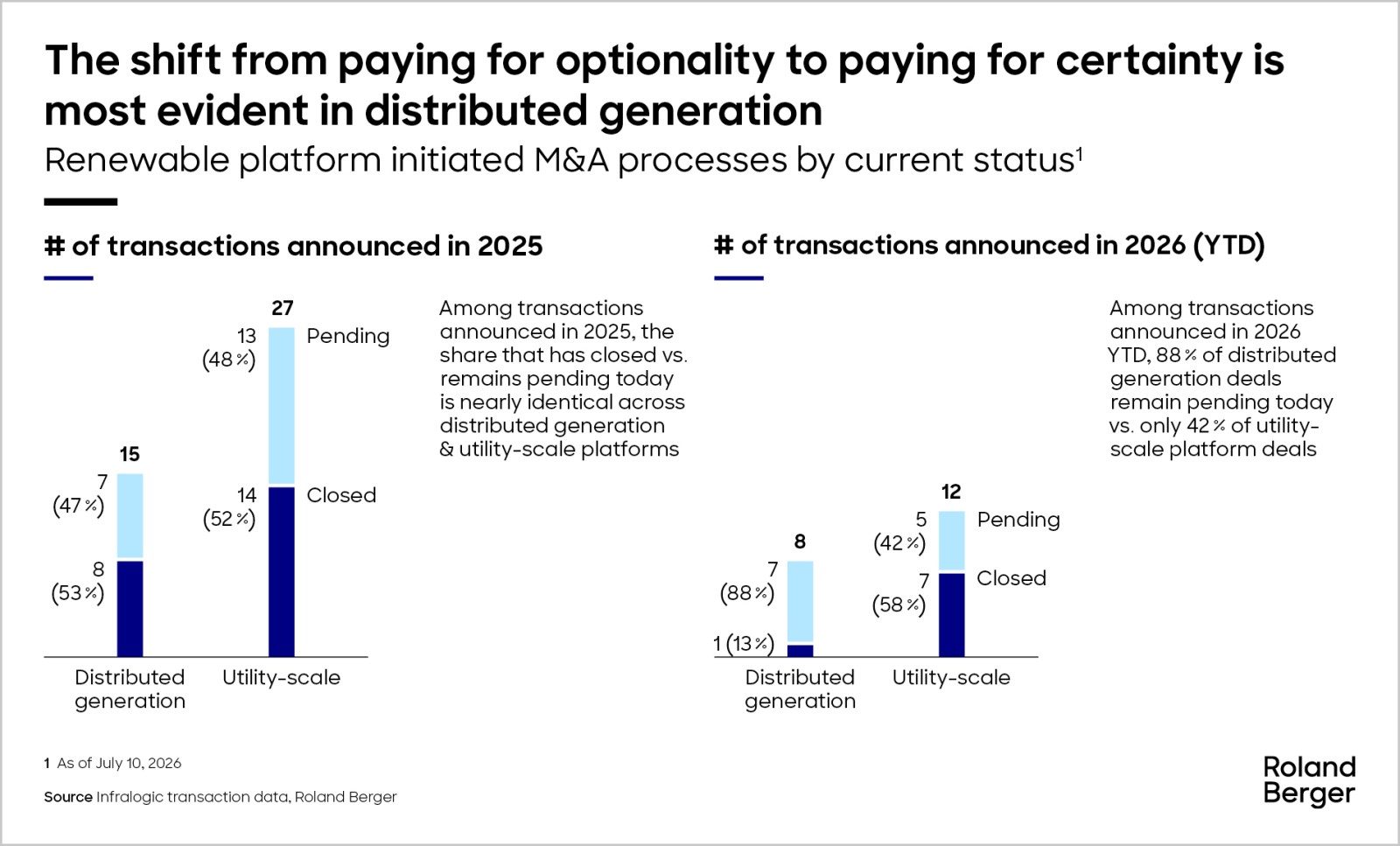
Over 40 North American renewable platforms launched M&A processes in 2025, with roughly half unsuccessful or still ongoing. This illustrates how quickly buyer underwriting standards changed.
The distributed generation market remained particularly crowded and capital constrained. Many founder-owned platforms are seeking strategic capital to continue growing independently, while buyers increasingly prefer scaled platforms with meaningful operating assets and proven execution capabilities. This disconnect is creating attractive acquisition opportunities for well-capitalized consolidators.
"Higher interconnection costs, stricter interconnection requirements, policy changes, and longer development timelines increasingly favor larger, better-capitalized platforms - accelerating the case for consolidation."

More significant than the decline in transaction activity was the change in investor behavior: the market shifted from paying for optionality to paying for certainty. Operating assets with contracted cash flows continued to attract strong interest. This preference has been reinforced by rapidly growing AI driven electricity demand, which has increased the value of projects capable of reaching commercial operation over the next several years. Development platforms with proven execution capabilities continued to command attention.
Early stage pipelines, however, were viewed very differently. Unless supported by scarce interconnection positions or exceptional locations, buyers placed significantly less value on projects that remained years away from construction.
Buyers have returned - but they are buying something different
Transaction activity has strengthened in 2026 as investors return to the market. However, the basis of competition has changed.
Recent acquisitions demonstrate continued demand for platforms with operating assets and advanced development portfolios. AI driven power demand has further increased the value of projects capable of reaching commercial operation in the near term.
The questions buyers ask today are different from just a few years ago: Can this platform consistently bring projects to commercial operation? Does it provide access to high quality interconnection positions? Can its development team be integrated into an existing organization? Will the acquisition improve execution, reduce overhead or lower the cost of capital?
Pipeline size alone is no longer enough. Even projects with executed Generator Interconnection Agreements (GIAs) are increasingly scrutinized, as buyers recognize that interconnection is only one of many hurdles between development and commercial operation.
"Scale, execution, and capital discipline are the new basis of competition in US renewables."

Renewable development has also become significantly more capital intensive. FERC Order No. 2023 increased upfront interconnection capital requirements through higher study and commercial readiness deposits (e.g., RD1 of USD 4,000/MW in PJM), while rising interconnection costs and competition for viable sites have further increased development costs (FERC). In some markets, distributed solar land option rates have increased by as much as fivefold, including observed increases in Maryland from approximately USD 2,000 per acre in 2019 to more than USD 10,000 per acre in 2026.
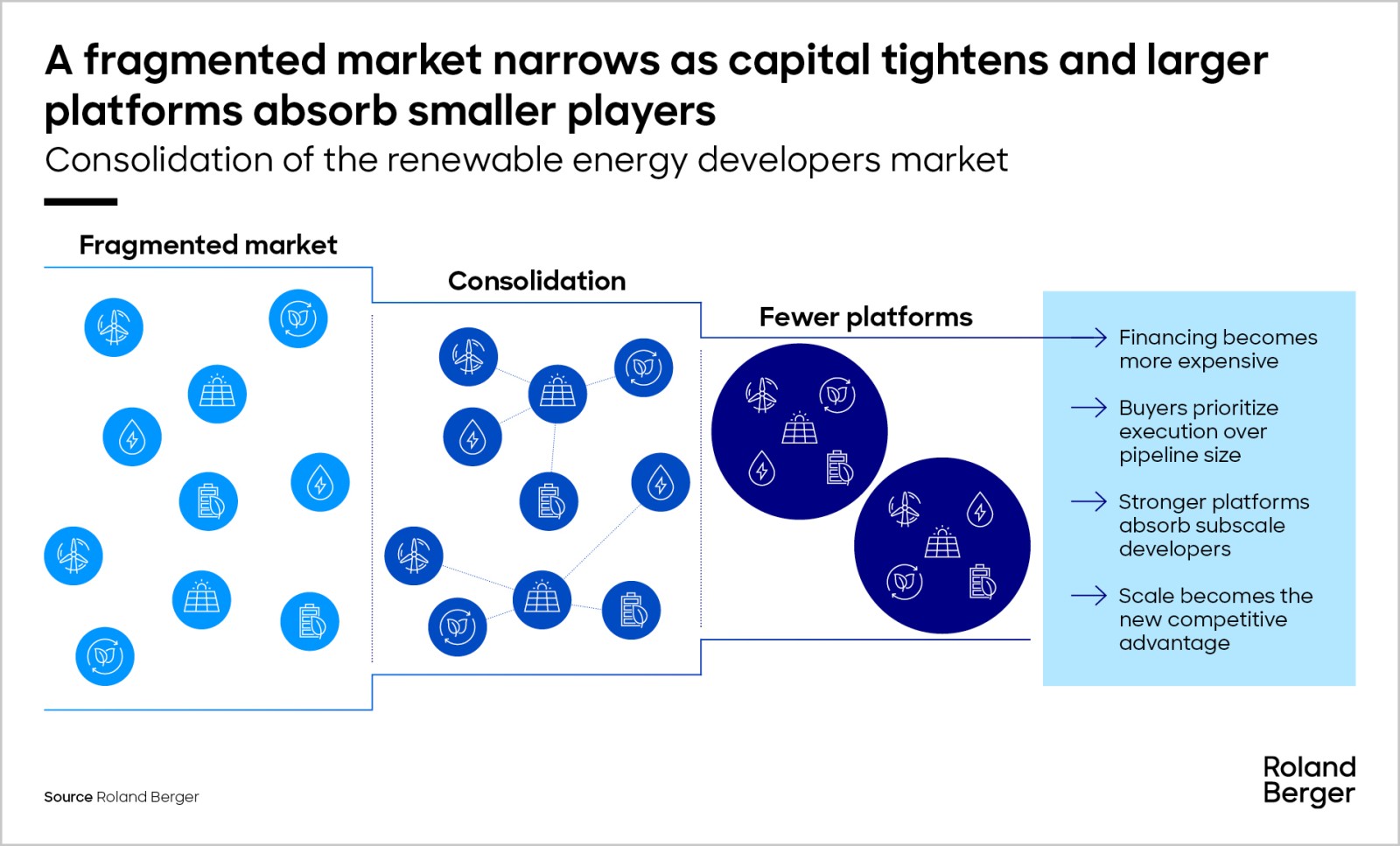
These changes increasingly favor larger platforms, which can spread risk across broader portfolios, access lower-cost capital and support experienced development teams through longer development cycles. As project timelines stretch beyond four to six years, these advantages become increasingly difficult for smaller developers to replicate (LBL 2026).
For many independent developers, consolidation is becoming a commercial necessity.
Strategic questions for the next phase of the market
The renewable development industry is unlikely to return to the conditions that defined the previous investment cycle. Capital remains available but is being deployed more selectively. Investors increasingly back platforms that can consistently develop, finance, build and operate projects, while stronger players continue to absorb sub-scale developers.
For developers, the strategic questions are clear: Is the platform large enough to remain competitive independently? Which capabilities genuinely differentiate it beyond its pipeline? Would a strategic combination reduce overhead and improve access to capital?
For investors, the parallel questions are equally pressing: Which platforms possess capabilities that are difficult to replicate? Where can acquisitions unlock meaningful operating synergies? And which development teams create greater value as part of a larger organization?
Looking ahead, consolidation may extend beyond renewable development itself. As AI driven power demand reshapes investment priorities, infrastructure and private equity investors are increasingly investing across the broader power value chain, including renewable development, generation, storage and data centers. In that environment, renewable development platforms may become valuable not only for the projects they own, but also for the strategic role they play in delivering new power to supply constrained markets.
FAQ
Sign up for our newsletter
Sign up for our newsletter and get regular insights on newest publications related to Energy & Utilities.
Further readings


