

The rapidly changing banking landscape means a paradigm shift for banking operations.


Financial wellbeing in Germany
By Viktoria Danzer, Georg Henig and Thomas Richter
Potentials for holistic financial solutions
Confidently managing one’s available money, achieving self-set goals, and being able to cushion financial risks well: those who act this way are in a state of "Financial Wellbeing." However, a representative survey of 1,000 participants conducted by Roland Berger together with the House of Finance & Tech reveals significant potential for improvement: 52 percent of respondents experience financial fears and worries at least once a week, and 27 percent state that they do not have sufficient control or overview of their finances.

Germany in the OECD Midfield with Room for Improvement
The average Financial Wellbeing Score in Germany is 53 points, placing it in the middle of OECD countries. This internationally recognized metric, developed by the American Consumer Financial Protection Bureau, measures financial wellbeing based on five categories: present, future, control, freedom, and stress.
Structural Need for Action with Opportunities for All
Financial Wellbeing is not a niche topic but a structural and societal concern. The study highlights specific challenges: inflation, demographic change, and evolving requirements for retirement provision create a need for new solution approaches. At the same time, the current market situation offers opportunities for innovative, holistic financial services.
This financial insecurity results from a complex interplay of various factors: macroeconomic developments such as inflation and demographic change, technological changes threatening jobs, and psychological biases leading to suboptimal saving behavior.
Win-Win Situation for All Stakeholders
Financial Wellbeing—defined as financial security and decision-making freedom both in the present and the future—offers advantages for individuals, financial service providers, and the state alike.
- For individuals: Less financial stress, strengthened resilience to unexpected events, and a lower risk of over-indebtedness. People who feel financially secure are more satisfied and productive.
- For financial service providers: Customer-centric offerings, higher completion rates through targeted cross-selling, and risk minimization. Nearly 53 percent of respondents would already use a simple, digital, and trustworthy Financial Wellbeing solution today.
- For the public sector: A financially better-secured population that is less dependent on state support and actively contributes to economic stability.
Individualized Solutions Instead of "One Size Fits All"
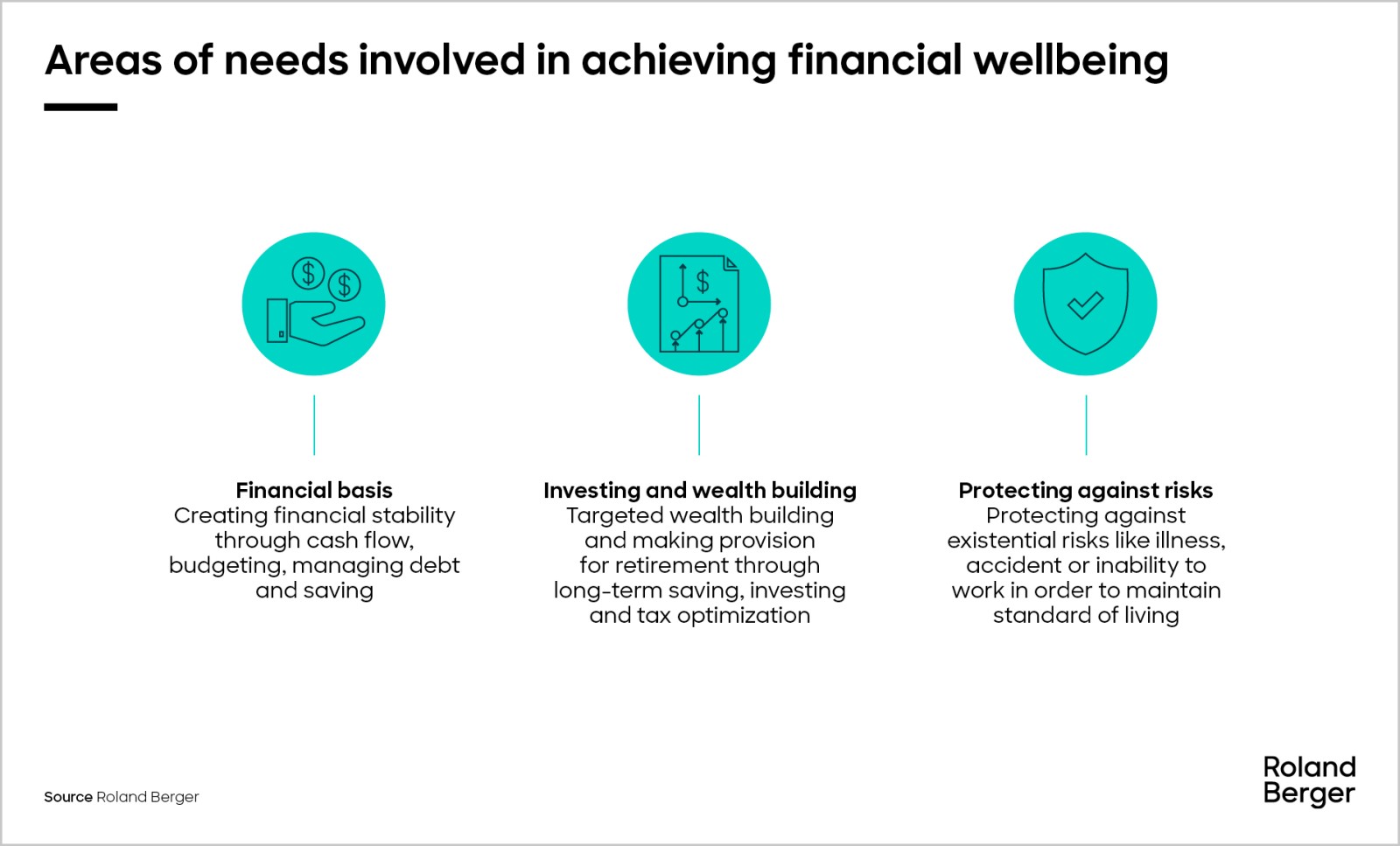
There is no "one size fits all" solution for Financial Wellbeing. Every offering must be tailored to real needs. The multidimensional framework developed by Roland Berger structures these individual needs and enables targeted addressing.
Financial needs vary greatly depending on life stage and wealth situation. While young people primarily need to build a financial foundation, middle-agers focus on structured wealth accumulation and retirement planning. The framework considers three central areas of need:
- Financial foundation: Daily financial management and basic security
- Investment and wealth accumulation: Retirement provision, saving, and wealth management
- Risk protection: Protection against unforeseen financial burdens
The Market: Fragmented Instead of Integrated
A central problem of the current market landscape is its fragmentation. Financial service providers mostly operate in silos and offer individual components such as savings plans, insurance, or robo-advisors, without orchestrating them along individual life realities. Holistic financial planning remains a privilege of the wealthy.
Over 30 percent of respondents do not achieve Financial Wellbeing because they do not take enough time for it, do not have a trustworthy advisor, or do not know suitable products. Here, existing potentials of financial service providers are simply not being exploited.
"Financial wellbeing is more than a trend — it is an opportunity to democratize financial planning and make holistic solutions accessible to all segments of the population."

Technology as a Democratization Opportunity
The solution lies in democratizing financial planning through digitalization and artificial intelligence. Currently available solutions only tap a small part of the potential of Financial Wellbeing. Data-driven, automated solutions provide more efficiency and offer the chance to reach entirely new customer groups.
Open Finance and APIs create the technological basis for personalized, scalable, and cost-efficient advice. Strongly digital or AI-driven data collection, analysis, and segmentation can massively reduce previous effort and make individualized financial planning accessible to broad population groups.
The State as an Enabler
The public sector can play an important role — through financial education, provision of infrastructure, and neutral orchestration of the emerging ecosystem. Examples from other countries show: Financial education can be successfully conveyed through mass media formats. Italy reached 4.5 million viewers with a quiz show and significantly improved the population’s financial knowledge.
The prerequisites for a Financial Wellbeing ecosystem include legal and tax incentives, digital infrastructure, and the legislative framework for transparency and fairness.
Time to Act
Better dissemination of financial knowledge among the general population is one of the key prerequisites for financial self-efficacy. The state is also called upon here.
Financial Wellbeing is a strategic imperative—for individuals, for the financial sector, and for society as a whole. The results of the study are a call to action for the financial industry, policymakers, and technology leaders. It is time to democratize financial planning in Germany.
The opportunity is there. Now, financial institutions, innovators, and regulators must take the step from fragmented products to holistic, user-centric solutions. Financial Wellbeing as a contribution to more resilience, freedom, and self-efficacy has not only an individual but also an important societal dimension.
Request the full PDF here
Register now to access the full study and explore the Financial Wellbeing Report. Furthermore, you get regular news and updates directly in your inbox.
Further readings


